Sleep and Screens
Kids, Phones, and Sleep: A Research-Backed Parent Guide
Why bedtime phone use can affect sleep, what studies actually measure, and a realistic family routine for quieter nights without endless arguments.
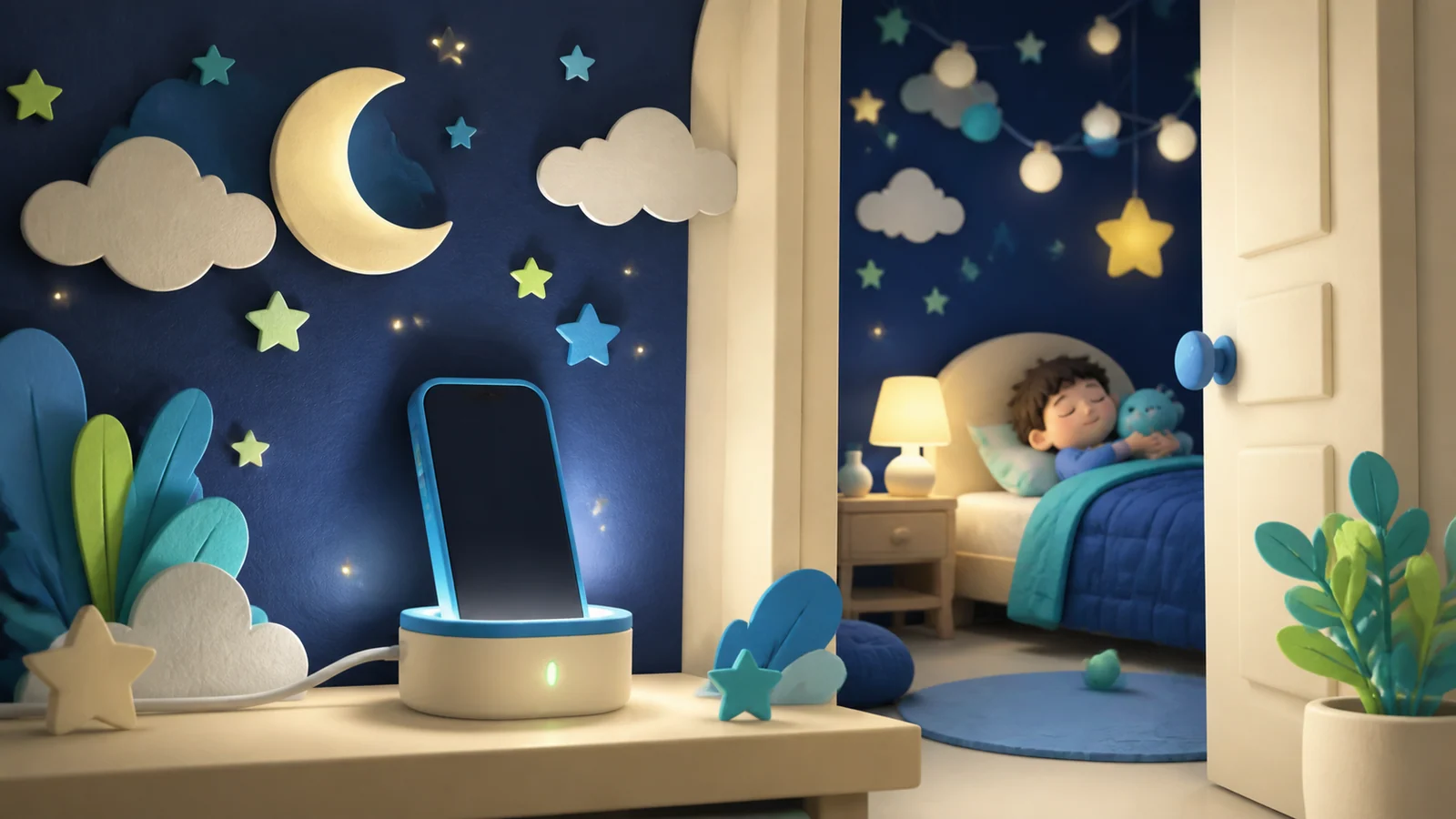
Phones can disturb sleep in several ways at once: they consume time, deliver stimulating content, invite social checking, and remain available for every nighttime wake-up. Reviews consistently report associations between screen use—especially near bedtime—and shorter or poorer sleep among school-age children and adolescents.[1][2]
The evidence is meaningful but not perfectly causal. Many studies rely on self-report, and family stress or existing sleep difficulties can influence both phone use and sleep. The safest conclusion is practical: late-night access creates avoidable sleep risks, and changing the routine is low cost.
Four pathways from phone to lost sleep
Time displacement
A child who intends to watch for ten minutes may lose an hour to autoplay, messaging, or a game. The bedtime stays fixed in theory while actual sleep moves later.
Mental and emotional activation
Competitive play, upsetting news, social comparison, or an unresolved message can keep the mind alert. Fear of missing out is one factor associated with nighttime social-media behavior.[4]
Light and timing
Bright light in the evening can affect biological timing, although content and displacement are also important. A dim screen is not permission for an unlimited session.
Constant availability
A phone beside the pillow turns every notification or brief awakening into a new decision. UK cohort findings link heavier social-media use with later sleep timing and disrupted patterns, while still leaving room for confounding factors.[3]
Build a routine the family can repeat
Choose a consistent “screens parked” time, usually 30–60 minutes before the intended sleep time. Place chargers in a shared location outside bedrooms. Use a separate alarm clock if the phone’s alarm is the reason it stays beside the bed.
Then create a short replacement sequence: wash, prepare clothes or a school bag, read, listen to calm audio, and lights out. Removing a compelling activity without replacing its function makes the rule harder to sustain.
For older teens, agree on exceptions before they happen—for example, a late school project or a call with family in another time zone. An exception should have a clear end rather than quietly becoming the new routine.
Reduce the pull before bedtime
- disable nonessential notifications;
- turn off autoplay where possible;
- move high-conflict group chats out of overnight alerts;
- schedule downtime or app limits;
- keep the same charger location for adults when practical; and
- use “Do Not Disturb” for genuinely necessary contacts.
Parental controls help make the expected stopping point predictable. They work best when the child knows the schedule and has a way to request a legitimate exception.
Measure outcomes, not obedience
Try the new routine for two weeks and track bedtime, approximate sleep onset, morning difficulty, daytime sleepiness, and family conflict. Do not demand perfect data. The question is whether sleep and daily functioning improve.
One study suggests sleep may help explain part of the observed relationship between adolescent screen exposure and depressive symptoms.[5] That does not mean every tired or sad teen has a phone-caused problem. It does make sleep a sensible first area to protect.
When the phone is not the whole problem
Persistent insomnia, loud snoring, breathing pauses, severe daytime sleepiness, or a major mood change deserves professional assessment. Removing a device will not treat a sleep disorder, anxiety condition, or unsafe social situation.
The family takeaway
The goal is not to prove that all screens damage sleep. It is to remove the most preventable pathway: an attention-demanding device available through the night. A shared charger, a clear stopping time, and a calm replacement routine are simple enough to test—and specific enough to help.
Sources
We identify organizations and evidence types so readers can evaluate each claim. See our editorial policy.
- Screen time and sleep among school-aged children and adolescents: a systematic literature review — Sleep Medicine Reviews (2015). Systematic literature review.
- Digital Media and Sleep in Childhood and Adolescence — Pediatrics (2017). Peer-reviewed evidence review.
- Social media use and adolescent sleep patterns: findings from the UK Millennium Cohort Study — BMJ Open (2019). Cross-sectional cohort analysis.
- Fear of missing out and sleep — Journal of Adolescence (2018). Peer-reviewed study.
- Sleep mediates the association between adolescent screen time and depressive symptoms — Sleep Medicine (2019). Peer-reviewed mediation analysis.