Online Safety
Loot Box Odds Explained With a Paper Probability Activity
Explain why a random reward is not guaranteed after a fixed number of tries. Use a no-purchase paper activity with clear assumptions and worked probabilities.
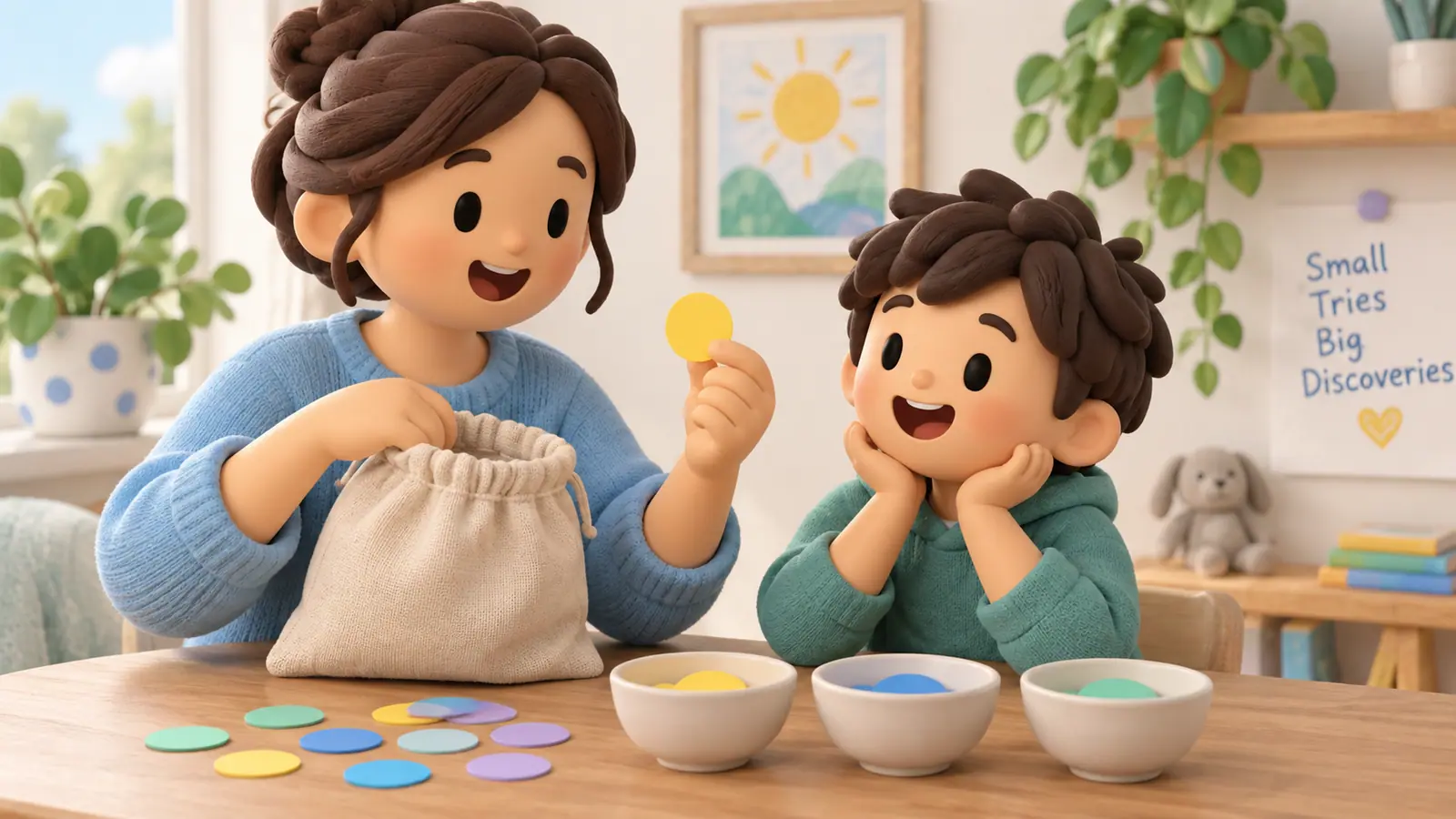
A stated chance of a reward is not the same as a promise that it will appear after a particular number of attempts. You can explain that distinction with paper cards and no purchases. Keep the activity about probability, not practicing how to spend on random rewards.
eSafety describes loot boxes as chance-based rewards. Real systems may have changing odds or special guarantees, so the mathematical assumptions below must not be applied automatically to a particular game.
Make a simple model
Prepare ten equal paper cards: one marked with a star and nine left blank. Shuffle them out of sight. A draw has a one-in-ten chance of selecting the star if each card is equally likely to be chosen.
After each draw, return the card and shuffle again. Returning the card matters: it keeps the same ten-card situation for the next attempt.
For children who might put paper pieces in their mouth, use an adult demonstration or a drawn discussion instead of loose cards.
Ask what ten tries promise
Some children will predict that ten draws must produce one star. Try a short demonstration, recording the outcomes without prizes or penalties. A sequence can contain no stars, one star, or several.
The probability model explains why. For independent draws with replacement, the chance of no star on one draw is 9/10. The chance of no star on ten draws is 0.9 raised to the tenth power, approximately 34.9%.
So the chance of at least one star in ten draws is approximately 65.1%, not 100%. An average or an expected count is not a guarantee for an individual sequence.
Compare three statements
| Statement | Correct under this model? |
|---|---|
| Each draw has a 10% chance of a star | Yes, with equal likelihood and replacement |
| After nine blanks, the next card must be a star | No; the next independent draw still has a 10% chance |
| If cards are not returned, the probabilities change | Yes; the remaining set is different |
That last row is essential. A model with replacement and a model without replacement are different. Some games also change probabilities after previous attempts; you would need their actual rules to analyze them.
Connect the idea to a purchase decision
Ask, “Would we still want this purchase if the desired item did not appear?” The family should not need a successful outcome to justify an amount it cannot comfortably spend.
If a child says another attempt is necessary because they have already spent money, pause. Earlier spending does not make an independent random event owe them the desired result.
Keep the activity separate from gambling practice
Use no money, wagers, prizes, or competition. Stop after the planned demonstration and discuss the pattern. The purpose is to understand uncertainty and marketing claims, not to make random rewards more appealing.
A family can choose not to allow purchases with uncertain contents at all. For practical payment boundaries, see in-app purchase controls. For fake reward offers or requests for account details, use the gaming scams guide.
Sources
We identify organizations and evidence types so readers can evaluate each claim. See our editorial policy.
- loot boxes as chance-based rewards — eSafety Commissioner. Source guidance.