Attention and Learning
Screen Time and School Performance
How entertainment, homework, multitasking, sleep, and family routines can relate to school outcomes—and what parents can change first.
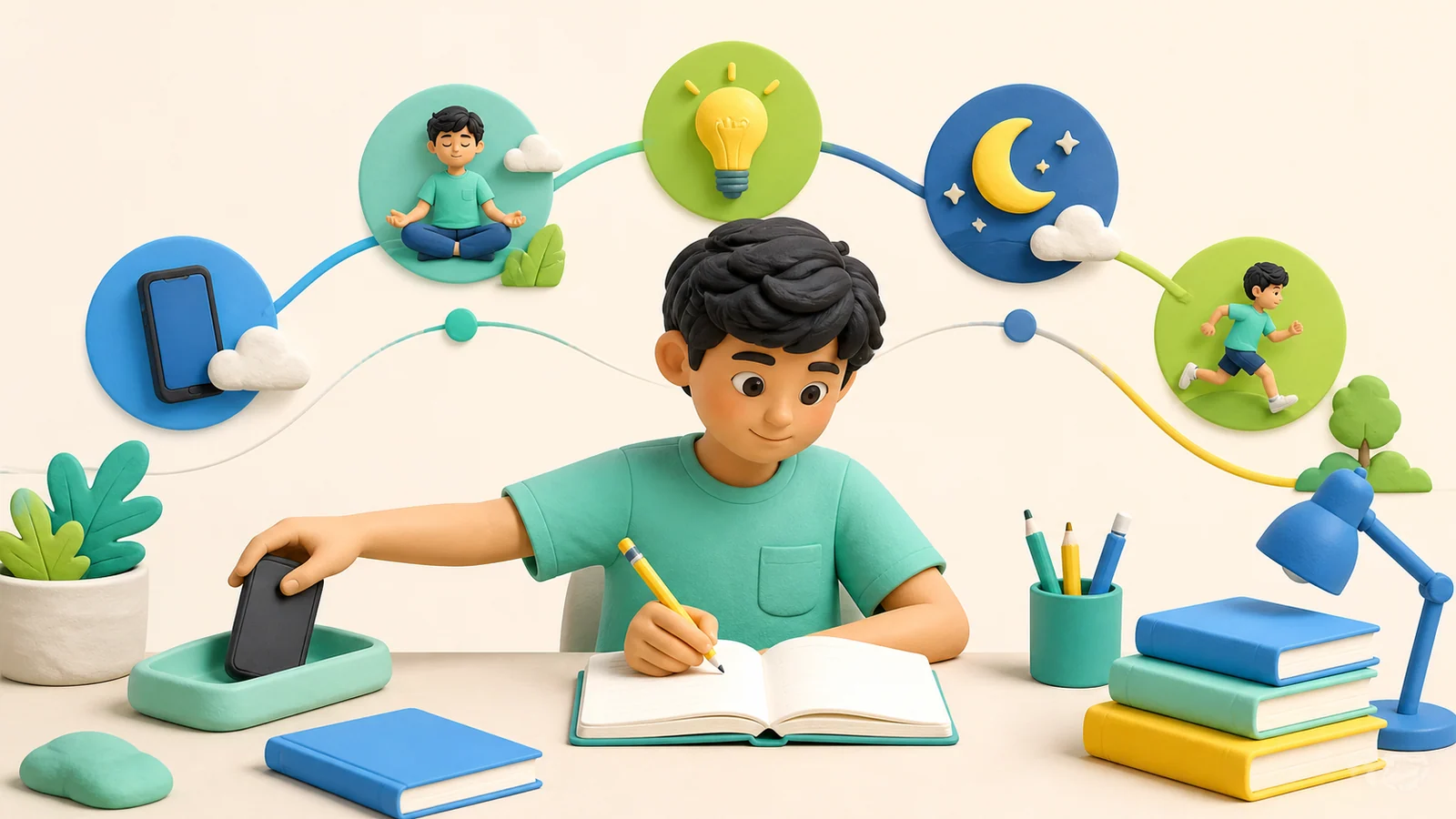
School performance and screen time are related in more than one direction. A phone can interrupt homework, but a device can also deliver the homework. A struggling student may escape into entertainment, while an exhausted student may have both more passive screen use and worse grades.
A systematic review and meta-analysis found that relationships differed by screen activity rather than supporting one simple rule for all media.[2] UNESCO similarly warns that independent evidence often lags rapidly changing education technology.[1]
Separate four kinds of use
Required school use
Learning platforms, research, accessibility tools, and teacher communication may be necessary. Judge them by whether they support the learning goal and whether the technology adds distraction.
Focused creative use
Coding, writing, music, design, and problem solving can involve long screen sessions with meaningful output. Breaks and ergonomics still matter.
Social and entertainment use
Games, messaging, and videos can be healthy recreation but may compete with homework when they are always available.
Simultaneous use
Trying to study while checking messages or short videos creates task switching. The child may spend longer “doing homework” while completing less.
Protect the conditions for learning
Start with a repeatable setup:
- Write the next concrete task on paper.
- Put the phone outside reach or shield entertainment apps.
- Keep only required tabs open.
- Work for an age-appropriate focus block.
- Take a short movement break.
- Check messages at the planned boundary, not during every pause.
For a child who needs the phone for authentication or a class group, allow that specific function and keep entertainment unavailable.
Sleep is part of school performance
Prospective research examining health behaviors suggests academic achievement sits within a combination of sleep, movement, diet, and screen habits.[5] Do not make the phone the only target while a child is chronically sleep deprived or overwhelmed.
Move recreational screens out of the late-night period and evaluate morning readiness, attendance, and concentration over two weeks.
Look for disordered patterns, not hobbies
Research distinguishes heavy use from disordered use. Persistent loss of control and impairment in psychological, social, or school functioning deserves more concern than enthusiasm alone.[4]
Ask whether the child is missing assignments, avoiding school, lying about use, or abandoning valued activities. If grades fall without those patterns, investigate teaching fit, learning difficulties, bullying, health, and stress as well.
Work with the school
Ask teachers which digital tools are actually required and what “finished” work looks like. Agree on how to handle class messages after hours. For younger students, a printed checklist can reduce repeated platform checking.
Run a focused experiment
Choose one change for two weeks—phone outside the study area, notifications off, or entertainment beginning after a defined task. Track completed work, time to start, sleep, and conflict. If nothing improves, revise the hypothesis rather than automatically tightening every restriction.
The balanced conclusion
Screens do not have one uniform academic effect. Content, purpose, timing, multitasking, sleep, and the student’s needs all matter.[3] Families can act now by protecting focused work and rest while keeping useful educational access. If performance continues to decline, involve the school and a health professional rather than assuming the device explains everything.
Sources
We identify organizations and evidence types so readers can evaluate each claim. See our editorial policy.
- Technology in education: A tool on whose terms? — UNESCO Global Education Monitoring Report (2023). Global evidence report.
- Association Between Screen Media Use and Academic Performance Among Children and Adolescents — JAMA Pediatrics (2019). Systematic review and meta-analysis.
- Screen time among school-aged children aged 6–14 — Global Health Research and Policy (2023). Systematic review.
- The impact of heavy and disordered use of games and social media on adolescents' functioning — Journal of Behavioral Addictions (2018). Peer-reviewed study.
- Combined impact of diet, physical activity, sleep and screen time on academic achievement — International Journal of Behavioral Nutrition and Physical Activity (2017). Prospective study.