Online Safety
How to Teach Kids to Spot Ads Inside Videos and Games
Practice spotting ads, sponsorships, affiliate links, and branded play with original examples. Includes a family activity and a pause before purchases.
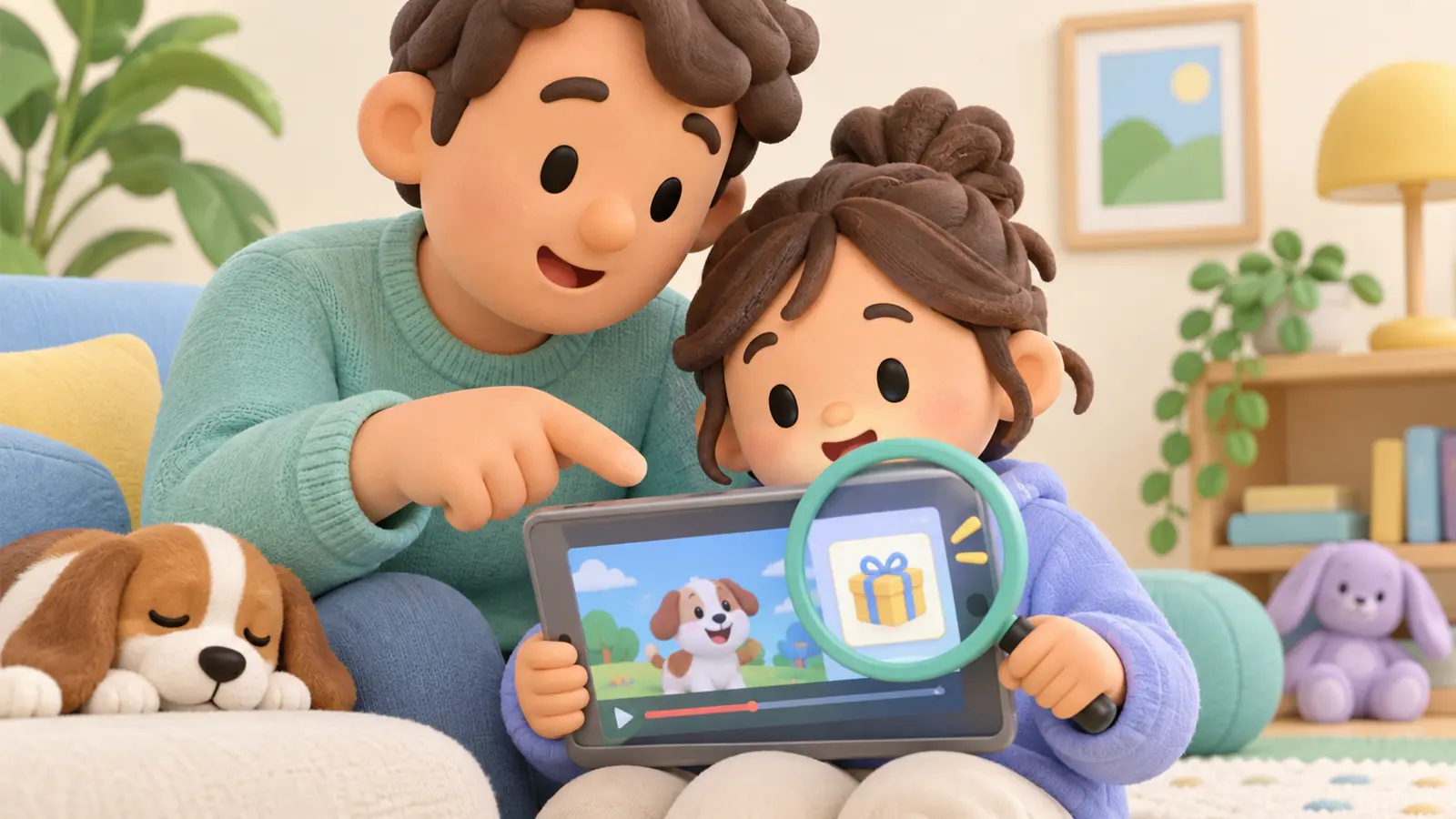
An advertisement does not always look like a separate commercial. It can appear inside a creator's video, an unboxing, a game, or a recommendation. Help your child ask who is promoting something, what action they want, and whether a commercial relationship is involved.
The FTC's guidance on blurred advertising explains why children may struggle to recognize marketing blended into entertainment. The practice scenarios below are invented so you can discuss the idea without opening a real purchase link.
Three questions to use together
Who benefits if I act? A creator, game publisher, advertiser, or seller may benefit from a purchase, visit, download, or sign-up.
What am I being asked to do? Buying is only one possibility. The request may be to watch longer, share personal information, invite friends, or move to another service.
What tells me this is promotion? Look for labels, sponsorship statements, affiliate disclosures, brand placement, and the surrounding context. A missing label does not prove that no commercial relationship exists.
Practice with four fictional situations
| Situation | What to discuss |
|---|---|
| A creator receives a free headset and recommends it | Receiving something of value can matter when evaluating the recommendation |
| A video includes a code that gives the creator a commission | The recommendation has a financial connection |
| A game area is built around a snack brand | The play experience may also promote the brand |
| A friend recommends a puzzle they bought themselves | This may be an ordinary personal recommendation; context still matters |
Do not train your child to accuse every enthusiastic person of lying. A recommendation can be sincere and commercially connected at the same time.
Separate liking from buying
A child can enjoy a creator and still decide a promoted product is unnecessary. Ask what problem the item would solve, what it costs in real money, and whether the family would want it without the video.
Try a pause rule for nonessential purchases. Save the item name or a private note, then discuss it at an agreed time. Do not require the child to keep reopening the promotion to remember the request.
Look at what the promotion leaves out
An exciting clip may show a best-case result without discussing setup, extra purchases, subscription renewal, or who the product suits. Ask what information you would need before deciding.
For a toy demonstration, that might include its actual size. For a game, it might include purchases and communication features. For a learning app, it might include what the child does after an incorrect answer.
Give the child a way to ask
Use a response such as “Bring me the name and we will look together” rather than “Never click anything.” The child needs a practical route when a promotion is confusing or appealing.
Keep the adult's example consistent. If you share a recommendation you were paid to make, explain that relationship plainly. Advertising literacy is harder to teach when household disclosures are vague.
Our digital citizenship guide offers related credibility questions. If a promotion leads to spending requests, use purchase controls on a child's iPhone alongside the conversation; a payment restriction does not itself teach a child to recognize an ad.
Sources
We identify organizations and evidence types so readers can evaluate each claim. See our editorial policy.
- guidance on blurred advertising — Federal Trade Commission. Source guidance.