Screen Time Research
Screen-Time Breaks for Kids: What Cognitive Pauses Might—and Might Not—Do
A break from a game is not always a break from the screen. Here is how to choose a pause that fits the need.
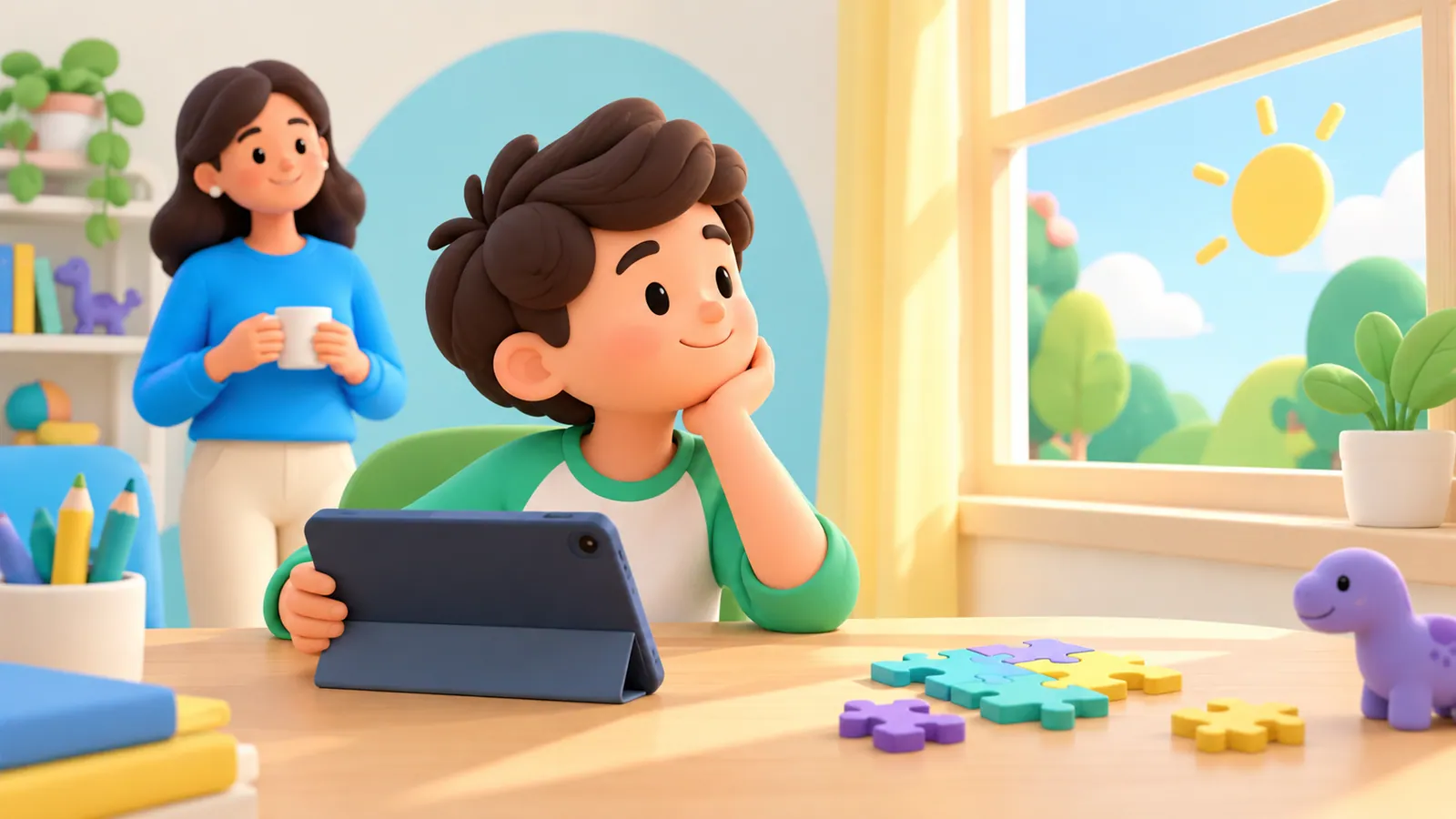
For a child who has been looking at a screen and sitting in one position, start with an actual break: look away, change position, and make room for an offline activity. Switching from a game to a math question on the same phone interrupts the game, but it does not give the eyes the same change of focus or get the child moving.
The right pause depends on what you want it to accomplish. A reminder to stop, a stretch, and an educational task solve different problems. None should become a reason to extend entertainment indefinitely.
Four things families call a “screen break”
| Type of pause | What changes | What it does not establish |
|---|---|---|
| Looking away from the display | The child stops focusing on the nearby screen | That overall screen use is balanced |
| Standing up or doing something offline | The child changes activity and posture | That a particular interval is right for every child |
| A warning before the end of play | The child receives information about the coming transition | That disappointment or conflict will disappear |
| A cognitive task inserted into entertainment | Access stops while another task is completed | That attention, self-control, or brain health improves |
This is a practical distinction, not a validated treatment framework.
Make ordinary breaks easy to take
The American Academy of Pediatrics' parent guidance suggests the 20-20-20 reminder for eye comfort: about every 20 minutes, look around 20 feet away for 20 seconds. It also recommends breaks from sitting and attention to the child's work setup. These are comfort and activity recommendations; they are not evidence that quizzes “reset” the brain. Persistent eye or back discomfort deserves a conversation with the child's clinician. AAP guidance on eye and back strain.
Put the next activity within reach. A child can place the tablet on its stand, look out of a window, get a drink, or join you in another room. A break plan that requires a parent to organize an elaborate activity every time may be difficult to maintain.
For games, learn where stopping is possible. Before a session, ask what happens if the child leaves during a round. Agree on a point for the next pause and a latest finish time. An endpoint is easier to explain when it was part of the original agreement.
What is a cognitive pause?
In the theoretical manuscript about effort-gated access and cognitive pauses, a cognitive pause means interrupting an entertainment session with a short task requiring active participation. It is a research proposal about the structure of access.
There are several competing possibilities. A pause could provide a useful opportunity to choose whether to continue. It could also become a button-pressing obstacle, frustrate the child, or make the entertainment more desirable. Completing the task would show that the child completed that task. It would not, by itself, show improved self-regulation outside the app.
A systematic review of interventions to reduce children's screen time found small average changes across varied interventions. It did not establish that this particular cognitive-pause design produces developmental benefits. Evidence about a broad group of interventions cannot stand in for a test of one mechanism or product.
A break plan you can discuss before play
Use these prompts to make your own agreement:
- Our reason for pausing: eye comfort, movement, dinner, bedtime, or another specific need.
- Our cue: a parent reminder, an agreed timer, or a natural point in the activity.
- What happens next: where the device goes and what the child can do.
- Whether play resumes: the remaining window, if any, and the final stopping time.
- What to change: a task that is frustrating, a cue nobody hears, or a pause that repeatedly collides with a team activity.
An illustrative conversation: “After this round, we are putting the iPad down while we get our snack. We can check the clock afterward. Dinner still starts at the same time.” The useful part is the clear sequence. The snack is not something the child must earn.
Review the arrangement after a few ordinary days. Did it give the child a usable break? Did returning to the game create a second difficult transition? Sometimes one shorter session with a clear ending is easier than repeated interruptions.
Where OMO Kids fits
OMO Kids is described as connecting short educational tasks with timed access to selected entertainment apps on a child's iPhone or iPad. Its current public materials do not establish an automatic cognitive-pause feature inside an ongoing game. Do not choose it on that assumption. See OMO Kids and the setup requirements and first-access check.
A learning task before access can be part of a family's rules. Keep separate time for rest, movement, and sleep. Use the family media plan to decide where each belongs; children do not need to pass a quiz to deserve a break.
Sources
We identify organizations and evidence types so readers can evaluate each claim. See our editorial policy.