Family Routines
Family Media Plan: A Fill-In Template and Two Examples
An editable family agreement with room for schoolwork, entertainment, exceptions, adult responsibilities, and changes over time.
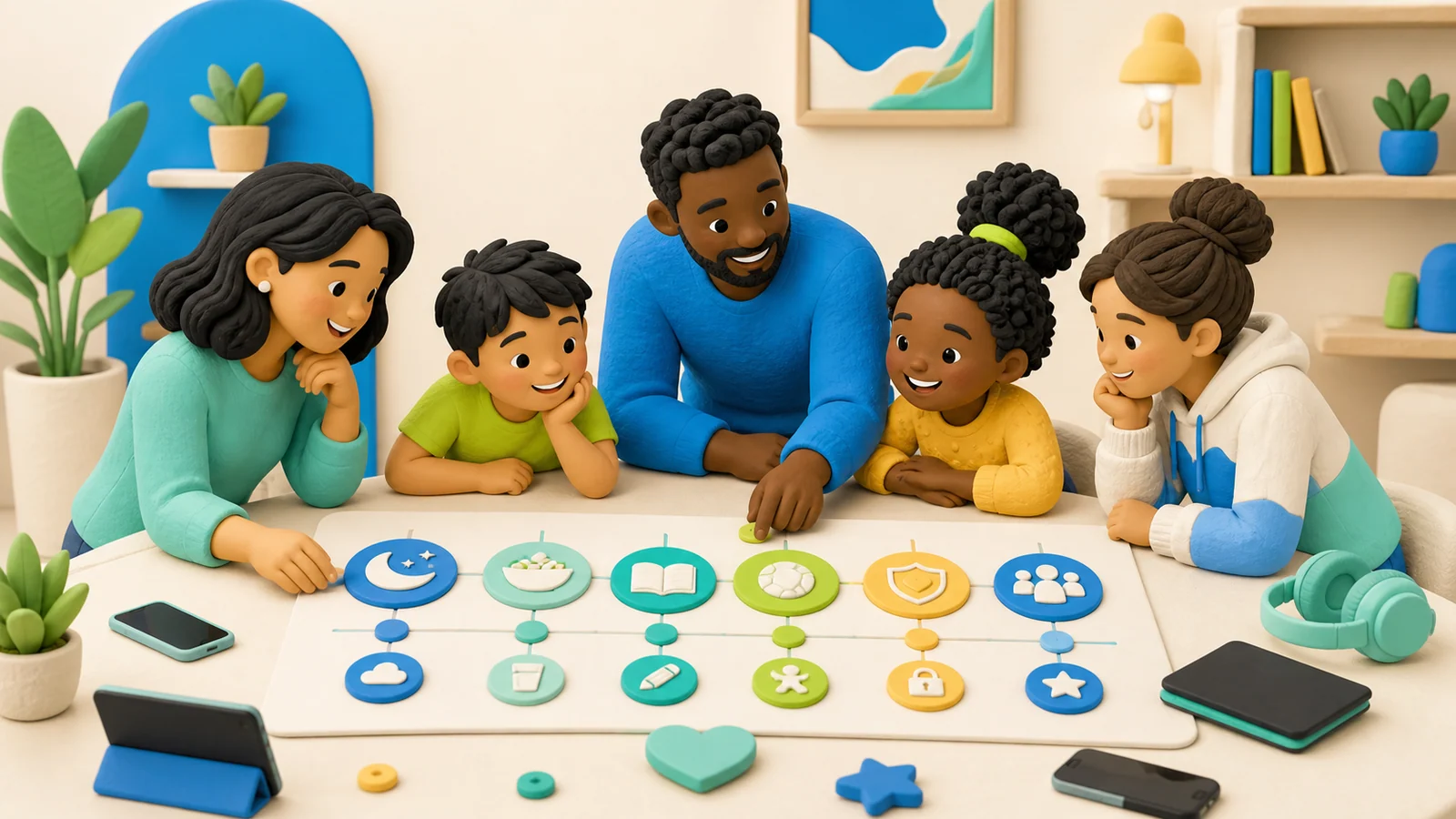
A family media plan is a short agreement about how devices fit into everyday life. It should explain the boundaries, what remains available, how to ask for an exception, and when the family will review the rules.
Start with a few decisions you can use this week. The American Academy of Pediatrics recommends a plan that fits the family, includes adults, and changes as children grow. You can also use its free family media plan tool.
Agree on the purpose before choosing settings
Ask each person what matters most: staying in touch, having time to play, getting schoolwork done, enjoying games, protecting privacy, or being ready for the next morning.
Choose three priorities. Then connect each rule to one of them. “We park entertainment devices before our bedtime routine” gives the family something concrete to discuss. “Everyone should use screens less” leaves the actual boundary undefined.
The plan below is an original planning aid. It is not a clinical protocol, a legal contract, or a promise that a particular set of rules will prevent conflict.
Copy, print, or fill in this family media plan
Use the blanks for your family's decisions. You do not need to complete every optional detail on the first day.
Our family media plan
People using this plan: ______________________________________
Starts on: __________________ Review on: __________________
Our three priorities: _________________________________________
1. When entertainment is available
School-day window or routine: ________________________________
Weekend or holiday arrangement: _____________________________
Stopping time or cue: _______________________________________
How we prepare to stop: _____________________________________
What we can choose to do afterward: __________________________
2. What stays available
Schoolwork apps, sites, or assignments: ________________________
Family communication and accessibility needs: _________________
How a mistaken restriction is reported: ________________________
3. Places and shared moments
Our device-free place or activity: ______________________________
Where devices stay when put away: ____________________________
One specific adult commitment: _______________________________
4. Content, contacts, and privacy
Who approves new apps, purchases, and account changes: ________
What we do about upsetting content or unwanted contact: _______
What an adult can see through our controls: ____________________
What we ask before sharing about someone else: ________________
5. Exceptions and changes
Who can approve an exception: _______________________________
How to ask: ________________________________________________
Examples of circumstances we will consider: ____________________
How we agree when the exception ends: ________________________
How other caregivers receive the updated plan: ________________
6. Repair and review
After a broken rule or argument, we will first: ___________________
At our review, each person can say what is working and ask to change:
One change we agree to try next: ______________________________
Example 1: a shared tablet and a short school-day window
This is an invented example to show how the template might be completed. It is not a recommended schedule or a report about a real family.
The Rivera family chooses three priorities: getting ready for school, time to play together, and contacting family. Their child uses a shared tablet.
Entertainment is available for a planned 20-minute session on selected afternoons, after a snack and the day's necessary tasks. A warning comes before the endpoint. The child chooses a drawing project or a game away from the tablet afterward. The family selects the duration for its circumstances; the example is not an age-based guideline.
The tablet stays on a kitchen shelf when not in use. A parent puts their phone away during the evening meal. Homework access and calls to relatives are handled separately from the entertainment window.
For an exception, the child asks the adult supervising that day. The adult names the reason and endpoint before changing access. If the tablet blocks an assignment by mistake, the child shows the adult what is needed.
They review the plan the following weekend, focusing on whether the afternoon routine is manageable.
Example 2: a child with a personal device and changing schedules
This second example is also illustrative.
The Chen family needs a plan that works around activities and two caregivers' schedules. Their priorities are school access, friendships, and a predictable bedtime routine.
Instead of one identical entertainment window every day, they agree on the next day's available time during the evening check-in. Necessary school tools and caregiver communication remain available under separate rules.
Their child can request an exception for a group project or a planned online activity with friends. The supervising adult confirms when it ends and shares the change with the other caregiver.
Both adults agree to ask before sharing images or stories about the child. If a rule is broken, the first step is to establish what happened and restore the relevant setting. A calm conversation follows later; they do not negotiate a new permanent rule during the argument.
At review, they consider whether the plan fits changing homework and activity demands.
Add controls after the agreement
A family can begin with the template and ordinary device settings. Show the child what the chosen settings affect and test an example together. Explain what a parent can actually see; do not imply hidden monitoring.
If your family selects OMO Kids, use the setup guide to check devices, accounts, roles, permissions, and the complete access cycle. A learning requirement is an optional addition to this plan, not a necessary part of every family's rules.
Review what happened in daily life
A short first review—after a week, for example—is a practical starting point, not a scientifically established interval. Discuss confusing rules, mistaken blocks, unclear exceptions, and adult commitments. Change one or two things you can realistically carry out.
Research on parental mediation of adolescents’ problematic online use reports mixed findings and limits to causal conclusions; it does not establish a single rule set that works for all families. Systematic review.
If the main difficulty is the conversation when a limit takes effect, use the parental-controls conversation guide. Keep the plan available where the people using it can find it.
Adapt the agreement to a specific situation
- Screens Before School: Build a Morning Routine That Gets Everyone Out
- Screen Time on Playdates: What to Agree Before Friends Arrive
- Sleepover Phone Rules: A Plan for Contact, Cameras, and Overnight Access
- Giving a Child Their Phone Back After a Broken Rule
- More Phone Independence for Teens: A Gradual Review Plan
- Your School Changed Its Phone Policy: A Family Preparation Checklist
- Screen Time When You Work From Home: Plan Around Real Availability
Sources
We identify organizations and evidence types so readers can evaluate each claim. See our editorial policy.
- How to Make a Family Media Plan - HealthyChildren.org — American Academy of Pediatrics.
- Linking parental mediation practices to adolescents’ problematic online screen use: A systematic literature review - PMC — PubMed Central.