Family Routines
My Child Won’t Stop Playing Roblox: A Plan for Ending Game Time
A practical ending agreement and parent phrases for Roblox sessions that repeatedly run into conflict.
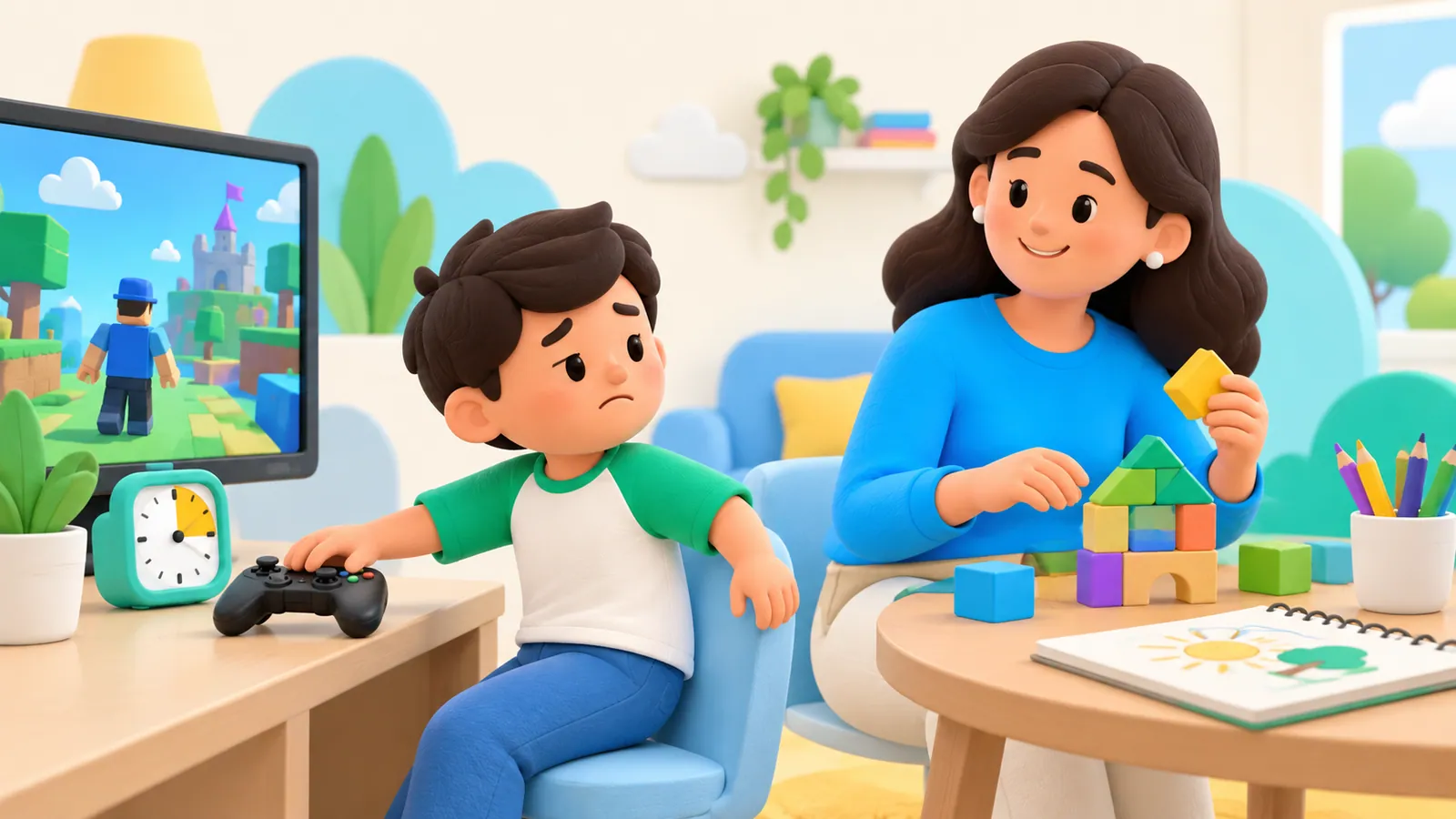
If Roblox time ends in an argument, start by making the ending clear before the next session begins. Decide when play stops, how your child will leave the game, and what comes afterward. Set the technical limit to match that agreement.
You do not have to solve the whole family's relationship with gaming during a difficult handoff. A first goal can be smaller: one ending that everyone understands.
Find out what “I can't stop” means this time
At a calm moment, ask your child to show you what they are playing. Keep the questions specific:
- “How do you know a round is nearly over?”
- “What happens if you leave right now?”
- “Are you playing with someone you know?”
- “Where could you stop without starting something new?”
The answers help you plan a stopping point. They do not require you to grant unlimited time. A game with a short round needs a different exit plan from an activity your child can keep extending.
For example, “Finish one more thing” is unclear if completing that thing immediately creates another goal. “Save what you can and leave by the time we agreed” gives the session an endpoint.
The American Academy of Pediatrics recommends involving children in understandable media rules and explaining the limit before play. It also notes that warnings help some children more than others. A timer is one option to try, not a guaranteed answer to every difficult transition. AAP guidance on screen-time transitions.
Make an agreement with four parts
Write a short version together. The example below is illustrative; its times are family choices, not a recommended daily allowance.
Today's Roblox plan
We can play from 4:30 to 5:00.
At 4:55, check whether there is time to finish what you are doing. Don't start a new activity that will run past 5:00.
At 5:00, say goodbye, leave the game, and put the tablet on its charging shelf.
Then choose: help make dinner or draw at the table.
If something about the plan needs to change, we'll talk about the next session after dinner.
You might instead use a shorter session, another part of the day, or a different next activity. The useful features are the stated end, the leaving action, and an available next step.
If your child needs to coordinate with friends, help them tell the friends when they will be leaving. That can turn “My parent suddenly made me disappear” into an expectation everyone knows in advance.
Adults need a commitment too. During the handoff, put your own phone down long enough to follow through. AAP's Family Media Plan encourages rules for adults as well as children, with space protected for family activities, sleep, and other priorities. Make a Family Media Plan.
Make the settings agree with your words
If the device blocks Roblox at 4:55 but you promised 5:00, fix that mismatch. If you repeatedly add extra time after saying the session is over, decide whether your written rule needs to change.
Roblox and Apple offer different controls. Use our Roblox limit setup guide for iPhone and iPad to check the account, age eligibility, and device settings. Do a short test before a session your child cares about.
A limit can make the end visible. It cannot know that a friend arrived late or decide how your family should handle an exception. Agree on who can approve an exception and when the conversation happens.
Avoid turning every session into a negotiation over the settings. If you choose to make an exception, name it clearly: “We agreed in advance to watch this event together today.” Then return to the usual rule next time.
What to say at the end
These are suggested phrases you can adapt, not scripts from a study or accounts of real families.
| Your child says or does | A possible response | What to handle later |
|---|---|---|
| “One more round!” | “You want another round. Today's session is finished.” | Whether the session fits the usual round length |
| “My friends are still playing.” | “I know you want to stay with them. It's time to say goodbye.” | Scheduling the next session when friends are available |
| “You didn't warn me!” | “The ending felt sudden. We still need to stop now.” | Whether the reminder was clear and useful |
| Keeps asking for another few minutes | “I've answered for today. We can discuss tomorrow after dinner.” | A clear time for reviewing the rule |
| Is too upset to discuss anything | “I'm here. We'll talk when things feel calmer.” | What was difficult and what support to try |
Use a phrase that sounds like you. You can acknowledge disappointment without reopening the allowance each time.
During an intense upset, an explanation about every reason screens need limits is unlikely to be the useful next step. AAP recommends staying calm and using few words rather than lecturing in the middle of a meltdown. Return to the discussion later. AAP's practical transition advice.
If the situation becomes unsafe, focus on keeping people safe and getting help, rather than completing the script or arguing over the device.
Review the difficult part after everyone has settled
You do not need a long post-game meeting. Try two questions:
“What made stopping difficult today?”
“What is one thing we can change before the next session?”
Choose a change you can observe. Perhaps the warning needs to happen beside your child instead of being called from another room. Perhaps the session keeps landing immediately before a rushed departure. Perhaps the next activity is too vague: “Go do something else” gives less direction than two available choices.
Keep a short note for several sessions:
| Session | What was agreed? | What happened at the end? | One adjustment |
|---|---|---|---|
| Example, not a real family record | Stop before dinner; put tablet away | End time was understood, but no next activity was ready | Set out drawing materials before play starts |
The point is to notice a pattern. You are not scoring your child's character or trying to make every expression of disappointment disappear.
If the same plan repeatedly fails, simplify it. One clear gaming window and a practiced handoff may be more manageable than many earning rules, warnings, penalties, and exceptions.
Is learning before Roblox a useful addition?
Some families prefer a short learning activity before entertainment. Others do better with a fixed gaming window that does not depend on completing extra work. Adding a learning requirement will not automatically solve the difficulty of stopping later.
If you want to try earning access, agree on it outside the conflict and keep the task manageable. Avoid adding harder questions or extra work in response to a child's frustration. Our guide to earning screen time through learning explains how to set the activity, the access, the overall boundary, and exceptions separately.
OMO Kids describes a learning-before-access cycle for selected apps, with temporary access and re-locking. It can support that chosen routine, but we do not claim it treats a gaming problem or guarantees calmer endings. Check the Apple family, device, and permission requirements before deciding whether it fits.
When to ask for more support
Pay attention to what gaming is crowding out. Persistent problems with sleep, schoolwork, family relationships, or activities your child previously enjoyed are reasons to speak with your pediatrician. A difficult ending or enthusiasm for Roblox alone does not establish a diagnosis. AAP advises seeking help when gaming interferes with other parts of life and efforts to change the pattern are not working. AAP guidance on unhealthy gaming.
For the next session, write down just three things with your child: the end time, the leaving action, and what you will do afterward. Put that plan where both of you can see it before Roblox opens.
Sources
We identify organizations and evidence types so readers can evaluate each claim. See our editorial policy.
- Screen Time & Temper Tantrums: Helpful Tips for Parents - HealthyChildren.org — American Academy of Pediatrics.
- How to Make a Family Media Plan - HealthyChildren.org — American Academy of Pediatrics.
- Unhealthy Video Gaming: What Parents Can Do to Prevent It - HealthyChildren.org — American Academy of Pediatrics.