Online Safety
Game Coins, Gems, and Real Money: A Cost Lesson for Kids
Help children translate game coins into real costs with a worked example. Separate item value, required top-ups, leftover currency, and the family budget.
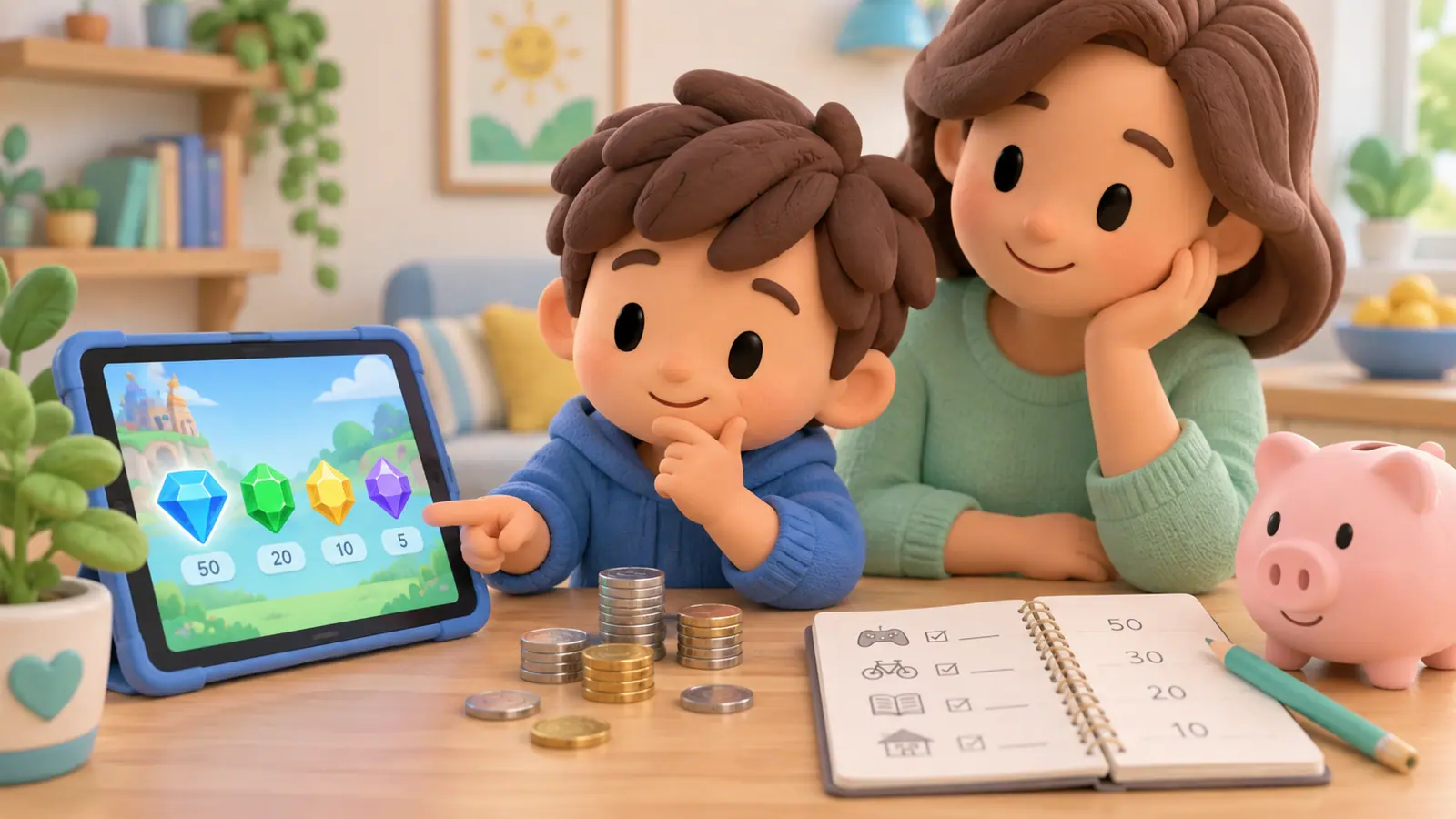
To explain game currency to a child, put the real payment beside the virtual amount. Then distinguish the item's proportional cost from the amount the family must actually spend to buy a currency pack. Those numbers are not always the same.
eSafety notes that in-game currencies can obscure real spending. The prices below are invented teaching examples, not current offers from any game.
Work through one fictional shop
Suppose a game sells 1,000 coins for $10. At that rate, 100 coins corresponds to $1. An item priced at 300 coins corresponds to $3 of that pack's value.
But if the child has zero coins and the only available pack costs $10, the required payment is $10, not $3. After buying the item, 700 coins remain in the game account. They are not automatically $7 that can be withdrawn or spent elsewhere.
Put all four numbers on paper
| Question | Fictional example |
|---|---|
| What does the currency pack cost? | $10 for 1,000 coins |
| How many coins does the item require? | 300 coins |
| What real payment is needed today? | $10 if no coins are already available |
| What remains afterward? | 700 coins subject to the game's rules |
If taxes, fees, bonuses, or different pack rates apply, include them in the real decision. Do not assume every coin has the same purchase cost across every pack.
Discuss the leftover-currency problem
A child may see the remaining 700 coins as a reason to keep shopping. Ask whether the family wanted another item before seeing the balance. Buying extra currency does not create an obligation to use it immediately.
Likewise, needing “just a few more coins” can trigger another full pack purchase. Look at the new real-money payment before approving the top-up.
Compare with an ordinary budget choice
Use a hypothetical entertainment budget the family is comfortable discussing. If $10 is allocated to this purchase, what other optional use of that $10 is being given up? Let the child explain the tradeoff without mocking the digital item.
The lesson is choosing with clear information. A virtual outfit can matter to a child, but that does not remove the spending limit or make the account balance cash.
Decide the request process
Ask the child to show the item, pack, total payment, and whether anything repeats automatically. Set the family budget in real currency. A limit such as “one pack” can become misleading when pack sizes or prices change.
Do not make a real purchase to demonstrate the arithmetic. A screenshot with private details removed or a drawn example is enough.
If spending already happened
Check the official receipt and purchase route with the responsible account holder. Follow the platform's current support or refund process where appropriate; eligibility varies. Avoid third-party “refund agents” asking for passwords or codes.
For the device setup, use purchase controls on a child's iPhone. For suspicious offers of free currency or account help, see our gaming scams guide.
Sources
We identify organizations and evidence types so readers can evaluate each claim. See our editorial policy.
- in-game currencies can obscure real spending — eSafety Commissioner. Source guidance.