Online Safety
Before You Post Your Child's Photo: A Family Consent Checklist
Decide whether to share a child's photo with an audience and consent check. Includes family scripts, group-photo choices, and handling removal requests.
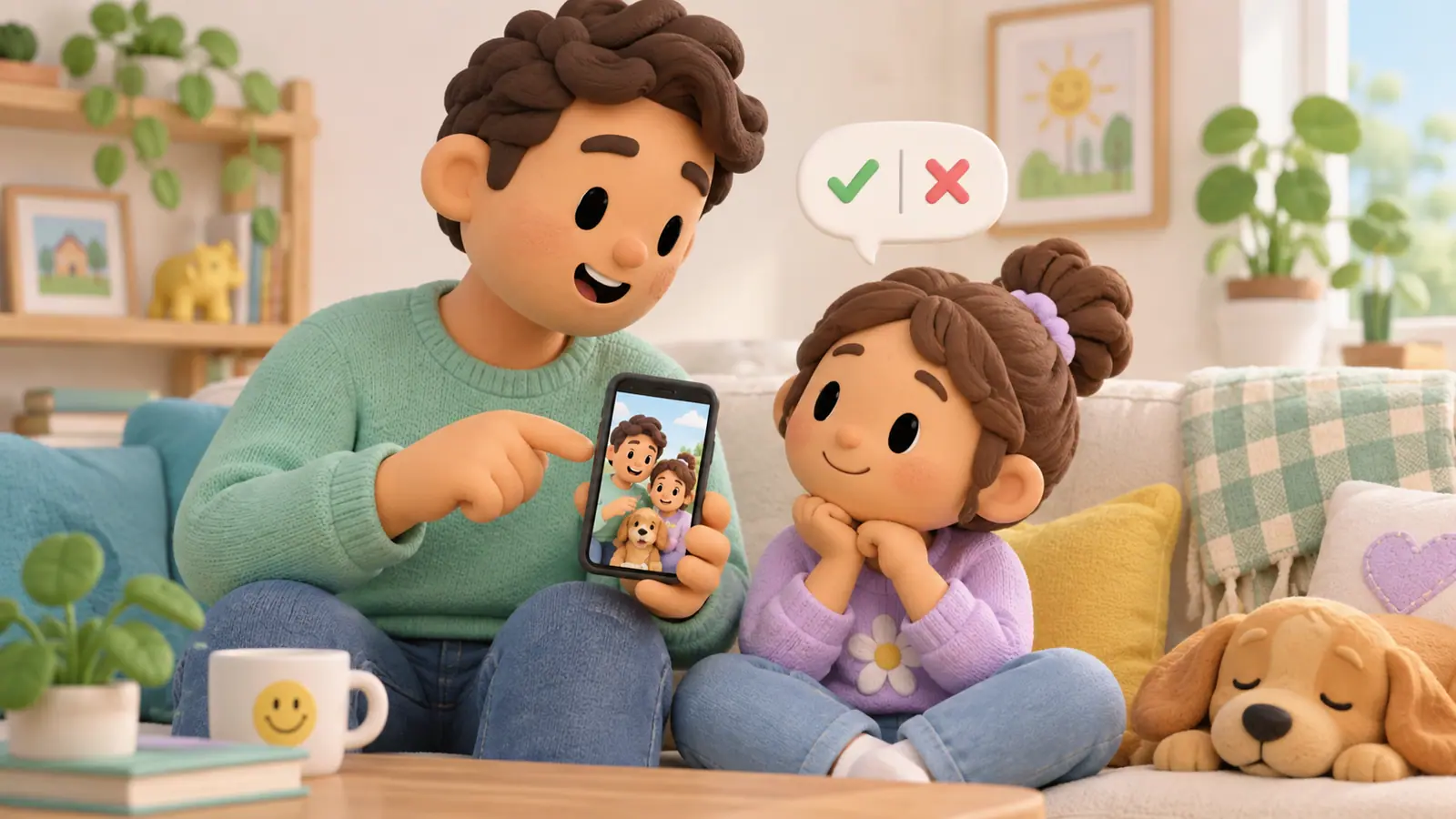
Before posting a child's photo, decide who needs to see it, what the image reveals, and whether the child is comfortable with that audience. Taking a picture for a private memory and publishing it are separate decisions.
eSafety's child privacy guidance recommends involving children in sharing decisions and limiting unnecessary identifying information. A private group still cannot guarantee that nobody will copy or forward an image.
Use a short decision card
| Question | A practical choice |
|---|---|
| Why am I sharing this? | Name the actual purpose or recipient |
| Does the child want this image shared? | Ask without pressuring for the answer you prefer |
| Are other children identifiable? | Check with their families and respect their wishes |
| Is a smaller audience enough? | Consider direct sharing or keeping it private |
| Would the child reasonably find this exposing or humiliating? | Keep vulnerable moments offline |
| Can we respond if someone wants it removed? | Know where it was posted and who can take it down |
This is a family decision aid, not a summary of photography law. School, club, platform, and local requirements can add separate obligations.
Ask about the specific audience
Try: “I like this picture of your model. May I send it to Grandma?” If you also want to publish it on a public profile, ask about that separately. Permission for one recipient should not silently become permission for everyone.
For a young child who cannot fully understand public sharing, the adult still has responsibility to minimize exposure. Avoid treating a smile at the camera as informed agreement to publication.
An example with three possible versions
Suppose your child has finished a school project and wants to show a relative. You could send a picture of the project alone, a picture of the child holding it, or a public post including the school name and class details.
Ask which version serves the purpose with the least unnecessary information. The project-only image may be enough. If the child prefers to explain it on a private call, that is another complete option.
The point is not to find a technically clever way around a refusal. It is to honor the child's preference where sharing is optional.
Make group photos an adult responsibility
At a playdate or party, check before posting identifiable children. Do not ask your child to collect permission from friends while adults stay out of the conversation.
If permission is unclear, keep the image private or choose a different photo. Cropping may help in some cases, but confirm that the person is no longer identifiable and that the resulting image is still appropriate to share.
Handle a change of mind plainly
If your child asks you to remove a post, listen and act on the request where you control the content. Explain honestly that removal cannot guarantee every copy disappears. eSafety's photo consent guidance emphasizes respecting requests about sharing and removal.
You can also tell relatives: “Please ask us before reposting pictures of the children.” Keep the message consistent with your own behavior.
For hidden location information and visible clues, use our location privacy guide. For teaching the same respect to children sharing others' images, see digital citizenship at home.
Sources
We identify organizations and evidence types so readers can evaluate each claim. See our editorial policy.
- child privacy guidance — eSafety Commissioner. Source guidance.
- photo consent guidance — eSafety Commissioner. Source guidance.