Gaming and Families
Gaming Disorder or Healthy Hobby? A Guide for Parents
A favorite game and a difficult stopping moment do not diagnose a disorder. Look at the persistent pattern and its effect on everyday life.
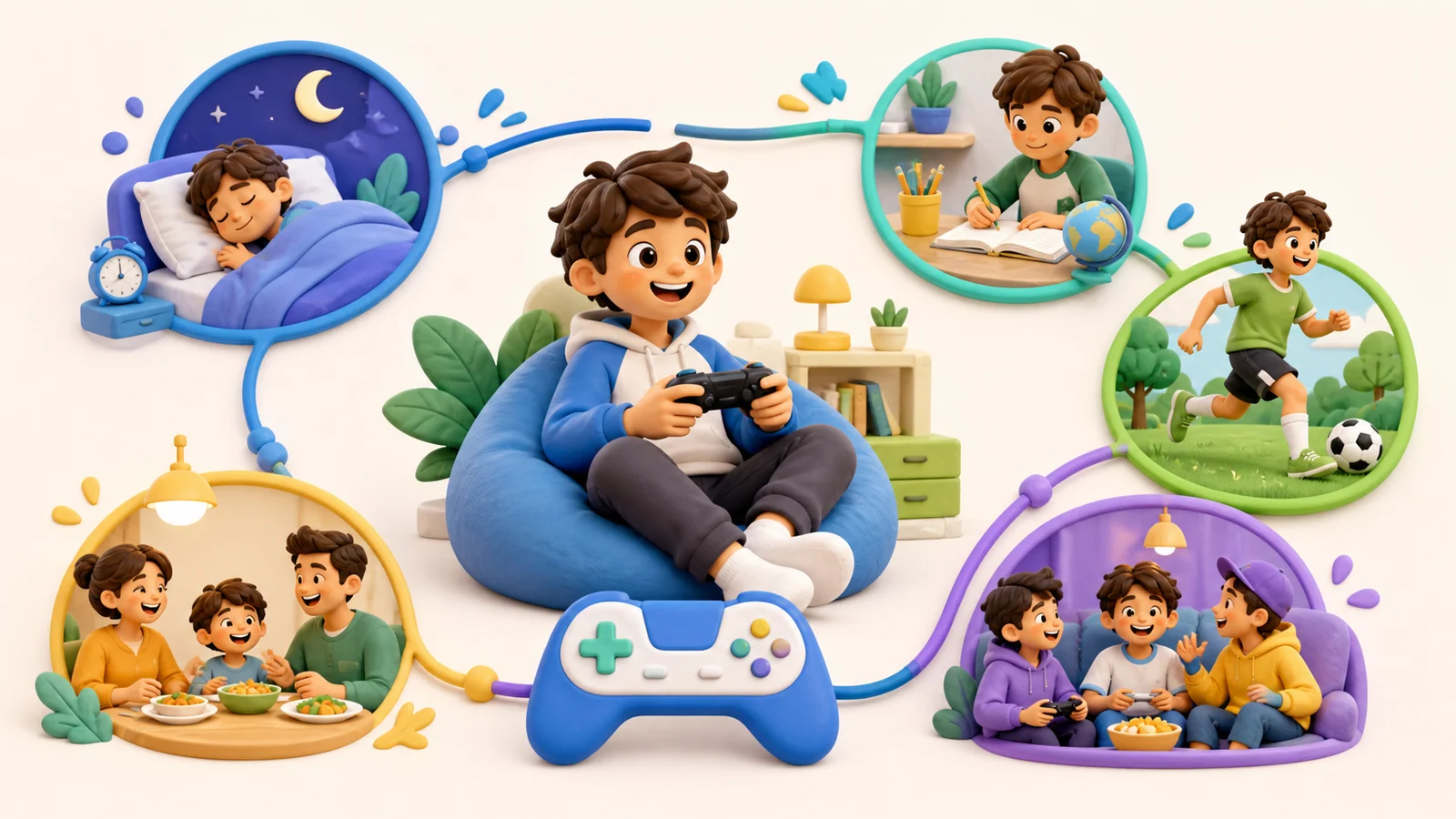
Enthusiasm for a game is not a diagnosis. A child may talk about Roblox, practice a skill, or spend extra time playing during a vacation while still participating in ordinary life. The more concerning pattern combines difficulty controlling play with continuing harm to important parts of that life.
Look beyond one long session or one angry response to a limit. At the same time, you do not need to prove a disorder before protecting sleep, addressing unsafe contact, or asking a professional for help.
What “gaming disorder” means
The World Health Organization's ICD-11 description concerns impaired control, gaming taking priority over other activities, and continued play despite negative consequences. Diagnosis requires significant impairment in functioning; the pattern is normally apparent for at least 12 months. That is a clinical framework, not a waiting period parents must complete before seeking support. WHO explanation.
In the United States, the American Psychiatric Association lists Internet Gaming Disorder in the DSM-5-TR section for conditions needing further research. Its proposed framework is gaming-specific and does not cover general phone use or social media. WHO and APA terminology should not be presented as identical diagnostic systems. APA explanation.
Three examples to help frame the question
These situations are fictional and illustrative. They cannot diagnose or rule out a disorder.
| Situation | What a parent can explore |
|---|---|
| A child is excited about a new game, plays more during a rainy weekend, and returns to usual routines afterward | Whether the temporary increase remains compatible with sleep, relationships, and other activities |
| A child protests whenever a device locks in the middle of a round but can stop at an agreed endpoint | Whether the timing and explanation of the rule need work; one transition problem is not enough for a diagnosis |
| Gaming repeatedly continues through the night and important responsibilities and relationships are deteriorating despite attempts to change | The pattern and its impact with a pediatrician or qualified mental-health professional |
Do not turn the table into a test. A child's broader circumstances may change the interpretation, and other difficulties can coexist with gaming problems.
Ask what the game offers
Invite the child to show you what they do in the game. They may be building something, spending time with friends, competing, or enjoying a place where the rules feel predictable. Ask which parts are hard to leave and what happens if they exit during a match.
An illustrative conversation: “I understand your friends are there. I've also noticed you are missing breakfast after playing late. Let's talk about how you can stay connected without losing sleep.” This acknowledges the valued activity while naming the specific concern.
Ask about the rest of life too. A child avoiding school may need help with school, not only a tighter timer. Do not assume gaming caused every difficulty that appeared around the same time.
Build boundaries the child can understand
Choose a clear play window, a stopping cue, and a place for the device afterward. Discuss exceptions before they are needed. Learn the approximate length of a round so that the family can decide when there is no longer time to start another one.
Keep essential communication, school access, and accommodations available. Adults should also be clear about spending and contact rules; those safety questions matter whether or not gaming disorder is present.
For a practical example, the agreement might say: “We won't start a new round after the warning. At the end, the iPad goes on the shelf while we get ready for dinner.” If the rule repeatedly creates a collision, revisit the plan at a calm time rather than renegotiating during every session.
For Roblox specifically, use the account and device limits guide. For the conversation at stopping time, see when a child won't stop playing Roblox. Controls support a boundary; they do not establish why a child is struggling.
What to bring to a professional appointment
When problems persist or meaningfully interfere with daily life, contact a pediatrician or qualified mental-health professional. You can ask for help even when you are unsure which label applies. The AAP advises additional support for recurrent difficult transitions accompanied by wider concerns. AAP guidance on screen-time transitions.
Useful notes include:
- When the difficulties began and what else changed around that time.
- Examples involving sleep, school attendance, relationships, mood, or safety.
- The child's explanation of what gaming provides.
- Agreements or device settings tried and what happened.
- Activities and relationships that are still going well.
There is no need to calculate an “addiction score” from this list. A clinician can consider gaming alongside other health, developmental, learning, and family needs. If there is immediate danger, seek emergency help rather than waiting for a routine appointment.
Where a parental-control app fits
OMO Kids describes a way for children to complete educational tasks before timed access to selected entertainment apps on iPhone or iPad. This is a household access mechanism, not a treatment for gaming disorder. Its setup guide explains the Apple family and device requirements.
Some families may prefer Apple's controls, Roblox's own controls, or a written agreement without another app. Choose a tool only after deciding what practical boundary it is meant to support. Judge progress through everyday functioning and the child's experience, not simply through the number of minutes a dashboard removes.
Sources
We identify organizations and evidence types so readers can evaluate each claim. See our editorial policy.
- Gaming disorder — World Health Organization.
- Psychiatry.org - Internet Gaming — psychiatry.org.
- Screen Time & Temper Tantrums: Helpful Tips for Parents - HealthyChildren.org — American Academy of Pediatrics.