Learning
“How Did You Get That?” Questions That Reveal a Child's Thinking
Discuss a child's math answer without an interrogation. Includes worked examples, specific prompts, and ways to explain thinking through words or drawings.
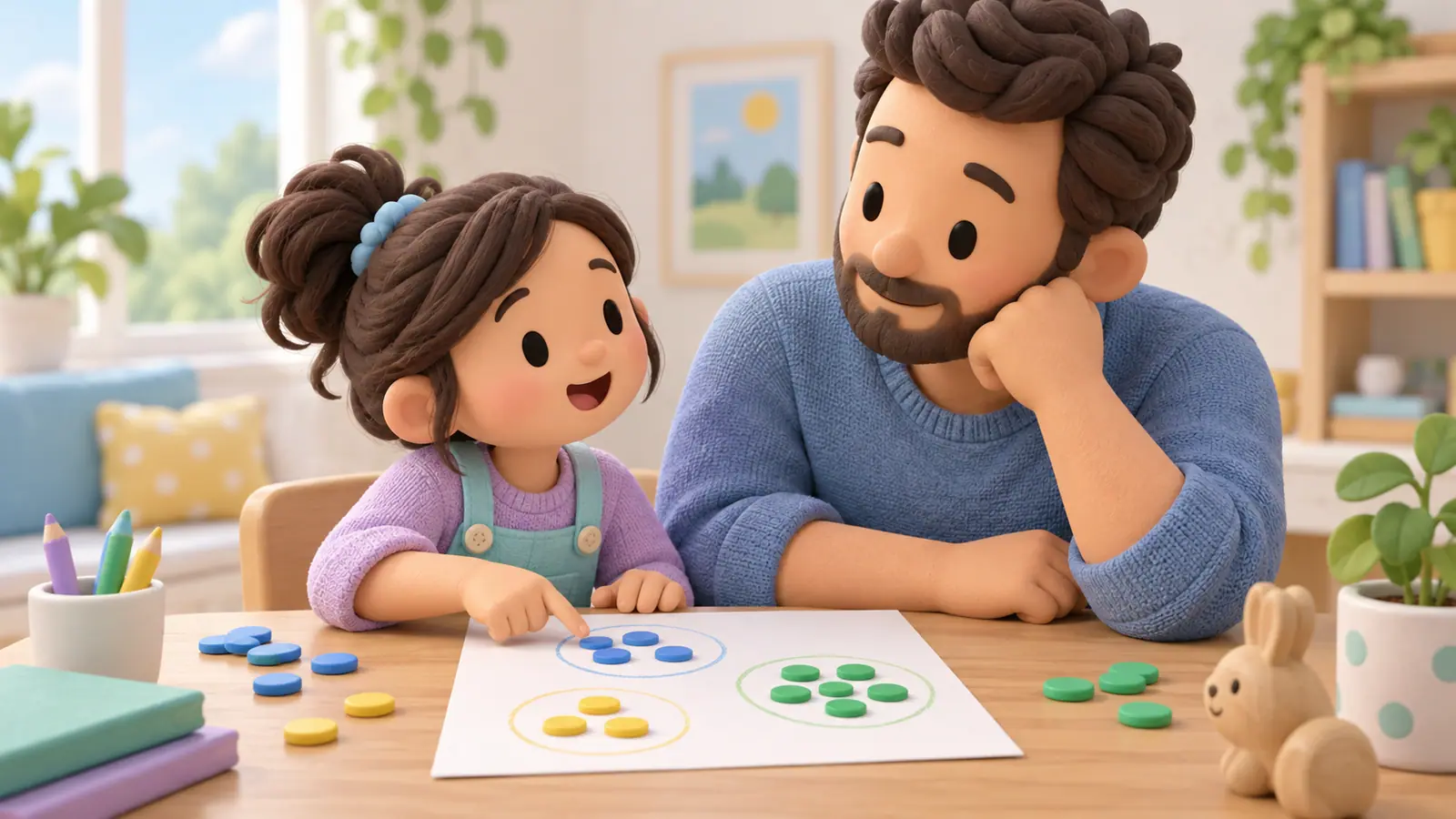
“How did you get that?” can open a useful conversation, but it can also sound like “I think you are wrong.” Tell your child why you are asking: you want to understand the method, including when the answer is correct.
Ask for an explanation on one selected problem. Requiring a speech after every easy answer can make a short practice session feel much longer than it needs to be.
Replace a broad question with a smaller one
Suppose your child answers 17 to 9 + 8. Try one of these prompts:
- “Which number did you start with?”
- “Did you use a fact you already knew?”
- “Can you show the part where you made ten?”
- “Would your method still work for 9 + 7?”
Possible methods include doubling eight and adding one, or splitting eight into one and seven. The child does not need to use the method you expected.
IES study guidance includes explanatory questions as a way to support understanding. The conversation prompts here are practical examples, not a scoring system for intelligence or mathematical ability.
Allow an explanation that is not a speech
A child may draw two rows of dots, move counters, write an intermediate calculation, or point to a number line. Ask them to connect that representation to the original question.
For 9 + 8, a drawing of ten dots and seven more can make the split visible. You can say, “I see the seventeen. Show me which dot came from the eight.” That question checks the relationship without demanding polished language.
If speaking or writing is difficult, keep the mathematical goal separate from the response format. An explanation can be valid even when it is brief or supported.
Use a correct answer with an incomplete reason
Imagine the question is whether 1/2 is larger than 1/4. The child answers yes and says, “Because two is smaller than four.” That shortcut happens to work for these unit fractions, but it does not explain all fraction comparisons.
Draw the same whole split into halves and quarters. Ask which single piece is larger and why. Later, compare 3/4 with 1/2 to show why the numerator also matters.
The aim is not to catch the child out. It is to find the boundary of a rule before the rule causes confusion.
When the child says “I just knew”
Sometimes a familiar fact really is recalled automatically. Accept that. Ask for a representation only when it serves a learning purpose, or choose a different problem that requires reasoning.
You can model your own thinking first: “I knew seven plus seven was fourteen, then added one.” Keep the model short and invite a different approach.
End with a choice, not a verdict
Ask which method the child would use again. If one method involves many more steps, discuss its usefulness without declaring it wrong. If the reasoning is incorrect, identify the specific step and check a fresh example together.
Our learning-before-gaming guide helps keep the task proportionate. If a digital activity only displays a score, use the educational app checklist to decide whether you also need a short conversation outside the app.
Sources
We identify organizations and evidence types so readers can evaluate each claim. See our editorial policy.
- study guidance — Institute of Education Sciences. Source guidance.