Learning
Family Quiz Night Without a Speed Contest: A Ready-to-Use Round
Run a cooperative family quiz with original questions, answers, and different ways to participate. Includes a scoring-free format and mixed-age adjustments.
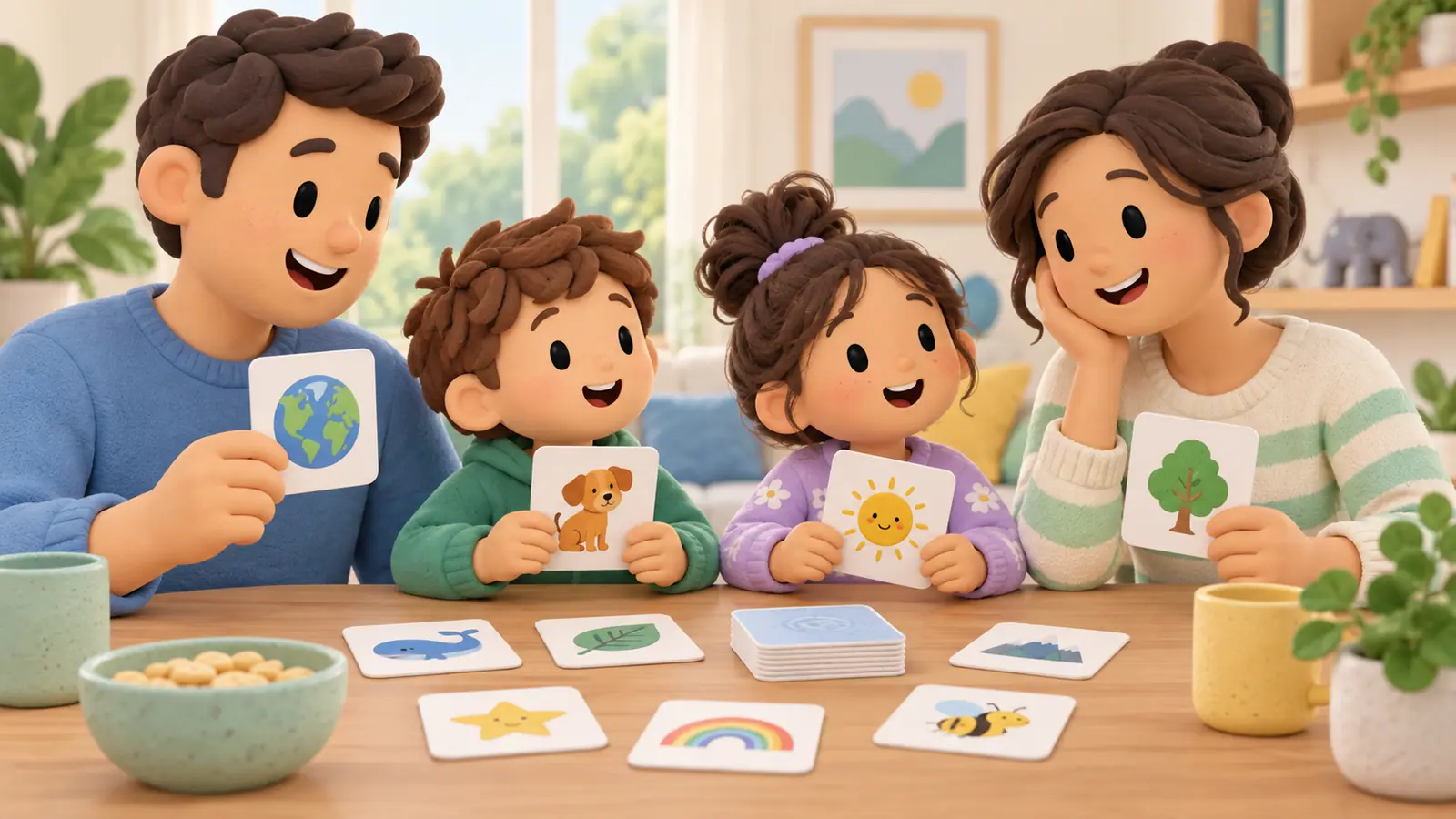
A family quiz night does not need buzzers, elimination, or a leaderboard. Try a cooperative round in which everyone helps build the answer and the family learns something from a correction. A younger child can draw or choose between options while an older child explains the reasoning.
Set the length before you begin. One round with six questions can be enough. The point is a shared activity, not finding the family member who knows the most facts.
Choose roles that rotate
One person reads the question, another explains the group's answer, and someone checks the answer key. Rotate roles so an adult does not become the permanent examiner.
Let people pass. If a question depends on school material one child has not encountered, offer a simpler entry point or solve it together. Age differences should not become a public ranking of ability.
A ready-to-use round
| Question | Answer or response guidance |
|---|---|
| A square has sides of 4 cm. What is its perimeter? | 16 cm: four sides of 4 cm |
| Which is larger, 3/4 or 1/2? | 3/4; show equal-sized wholes or a number line |
| In “The damp towel hung by the door,” what does damp mean? | Slightly wet |
| A fictional town opens a park in 2011 and a library in 2016. How many years apart? | Five years |
| A path is wet. Does that prove it rained? | No; another explanation, such as a sprinkler, is possible |
| Invent a useful object that combines a ruler and a bookmark. | Open-ended; explain how it would work |
The final question has no secret model answer. Label it creative so nobody waits to be told they guessed correctly.
Replace points with a shared record
Make three columns: “We knew,” “We worked out,” and “We want to check.” Put each question in the most useful column after discussing it.
A correct answer with a weak explanation might belong in “We want to check.” A wrong first attempt followed by a clear correction can belong in “We worked out.” This format makes the discussion visible without pretending it is a validated learning measure.
Make mixed ages workable
For the perimeter question, a younger child can count four sides while an older child adds their lengths. For the fractions question, one person shades a picture while another names the comparison.
Avoid giving the youngest child only decorative jobs. Give each participant something meaningful they can do. Adults can also model uncertainty instead of competing to answer first.
Handle an answer dispute
Ask what the question means and what evidence would settle it. Sometimes the wording is ambiguous. Rewrite it rather than forcing the family to accept the answer key.
If a factual answer needs checking, use a reliable source together after the round. Do not let the search turn into unrelated browsing. Put unresolved questions on the list and return when you have time.
End while it is still enjoyable
Invite each person to bring one question next time. Help children check their answers in advance, and include a mix of reasoning and creative prompts.
For more shared activities, see screen-free ideas. Our guide to different rules for siblings also explains why fairness does not always mean giving everyone an identical task.
Sources
We identify organizations and evidence types so readers can evaluate each claim. See our editorial policy.
- screen-free ideas — OMO Kids Editorial Team. Editorial guide.
- different rules for siblings — OMO Kids Editorial Team. Editorial guide.