Learning
Fractions on a Number Line: A Hands-On Guide for Parents
Teach fractions on a number line with paper strips, equal intervals, and simple examples. Includes answers and common mistakes to discuss with your child.
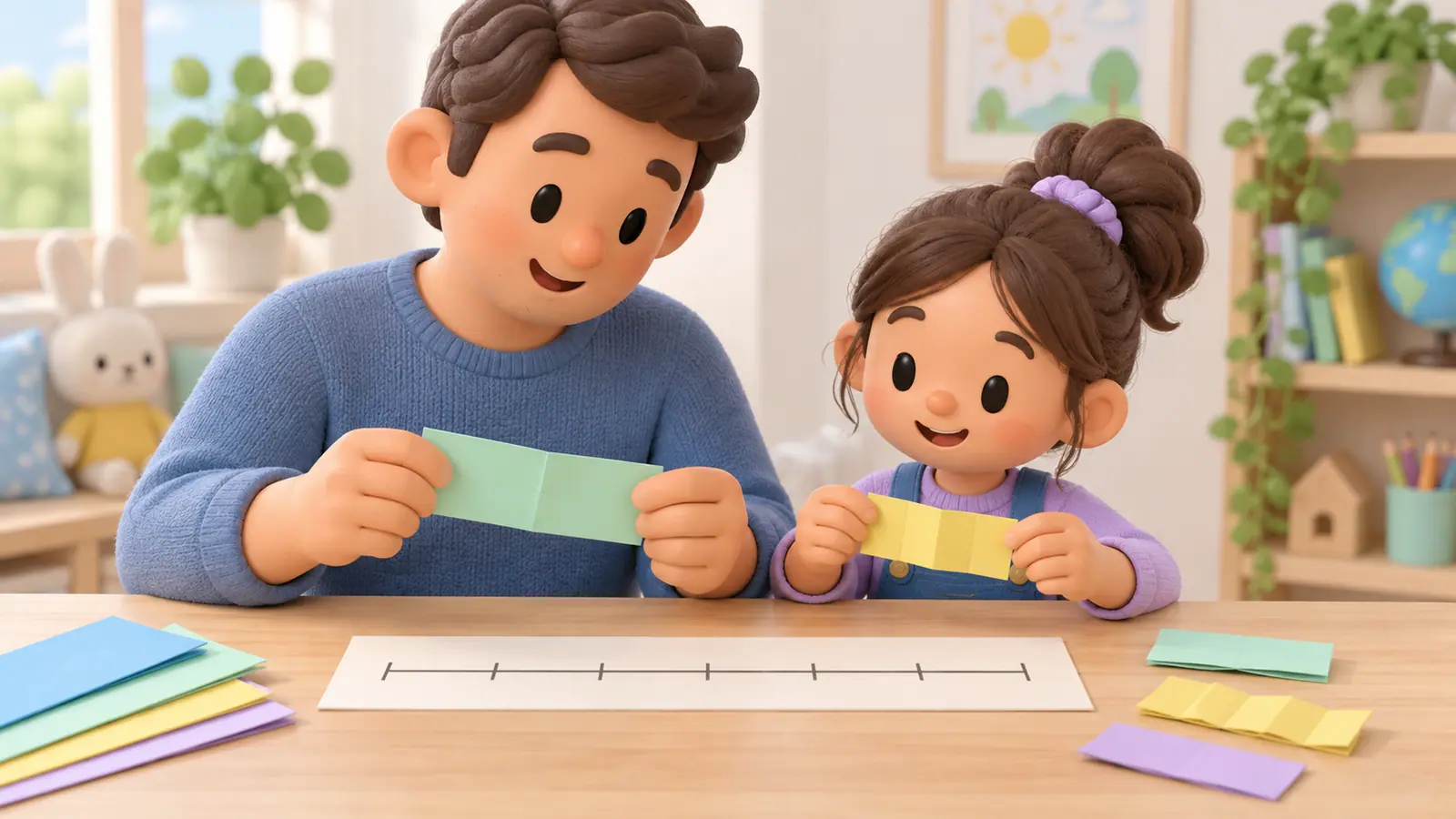
To practice fractions on a number line, start with the distance from zero to one, split it into equal intervals, and count those intervals. A strip of paper makes the idea visible. It also helps you notice a common mix-up: counting the marks instead of the spaces between them.
The Institute of Education Sciences includes number-line representations in its fractions instruction guidance. The activities here are original home examples, not a replacement for the sequence your child's teacher uses.
Make one whole before naming the parts
Draw a horizontal line. Mark 0 at one end and 1 at the other. Say, “This whole distance represents one.” Fold an equal-length paper strip in half, then use the fold to mark the halfway point.
There are now two equal intervals. The middle mark is 1/2 because it is one of those two intervals away from zero. Ask your child to trace that distance with a finger.
Avoid beginning with an unlabeled line. Without a defined whole, a child cannot reliably decide what a fraction represents.
Add quarters and compare positions
Fold the strip into four equal parts. Mark 1/4, 2/4, and 3/4 between zero and one. Compare the halfway fold with 2/4.
Ask, “Did one-half move when we used smaller parts?” It did not. Two quarters and one-half name the same position. Draw a second line directly underneath if writing several labels at one point becomes crowded.
Then ask which is farther from zero: 1/4 or 3/4. Have the child show the distance before choosing. This keeps the comparison attached to quantity.
Try these four questions
| Question | Answer and explanation |
|---|---|
| A line from 0 to 1 has four equal intervals. Where is the third mark after zero? | 3/4, after three quarter-length intervals |
| Which is larger, 1/2 or 1/4? | 1/2; it lies farther to the right |
| Which fraction matches 2/4? | 1/2; the positions coincide |
| Extend the line to 2. Where is 5/4? | One quarter past 1; it equals 1 1/4 |
For the final question, preserve the original unit length. Do not stretch the second whole to fit the page. Fractions larger than one become confusing when the size of a whole silently changes.
Three mistakes worth exploring
Unequal spaces. If the four parts have different lengths, they do not represent quarters. Use folds or a ruler to check without treating drawing accuracy as a character flaw.
Counting five marks as five parts. A line divided into four intervals has five boundary marks, including its endpoints. Count the spaces together.
Assuming a larger denominator means a larger amount. Compare 1/2 and 1/4 using the same whole. The denominator describes how many equal parts make the whole; one of more numerous equal parts is smaller.
Move from copying to explaining
After one supported example, offer a fresh line and ask your child to place 3/4. Later, try a line divided into eighths and locate 1/2. A correct answer on a different representation gives you more information than tracing the same finished drawing.
If this is already too much, return to halves. Home practice does not need to cover every fraction rule in one sitting. For choosing a manageable endpoint, see learning before gaming. If an app is involved, check whether its feedback explains the fraction, rather than only marking an answer red.
Sources
We identify organizations and evidence types so readers can evaluate each claim. See our editorial policy.
- fractions instruction guidance — Institute of Education Sciences. Source guidance.