Learning
Grocery Store Math for Kids: Prices, Change, and Unit Costs
Turn a shopping list into six small math activities using prices, change, quantities, and unit costs. Includes examples and answers without buying extra items.
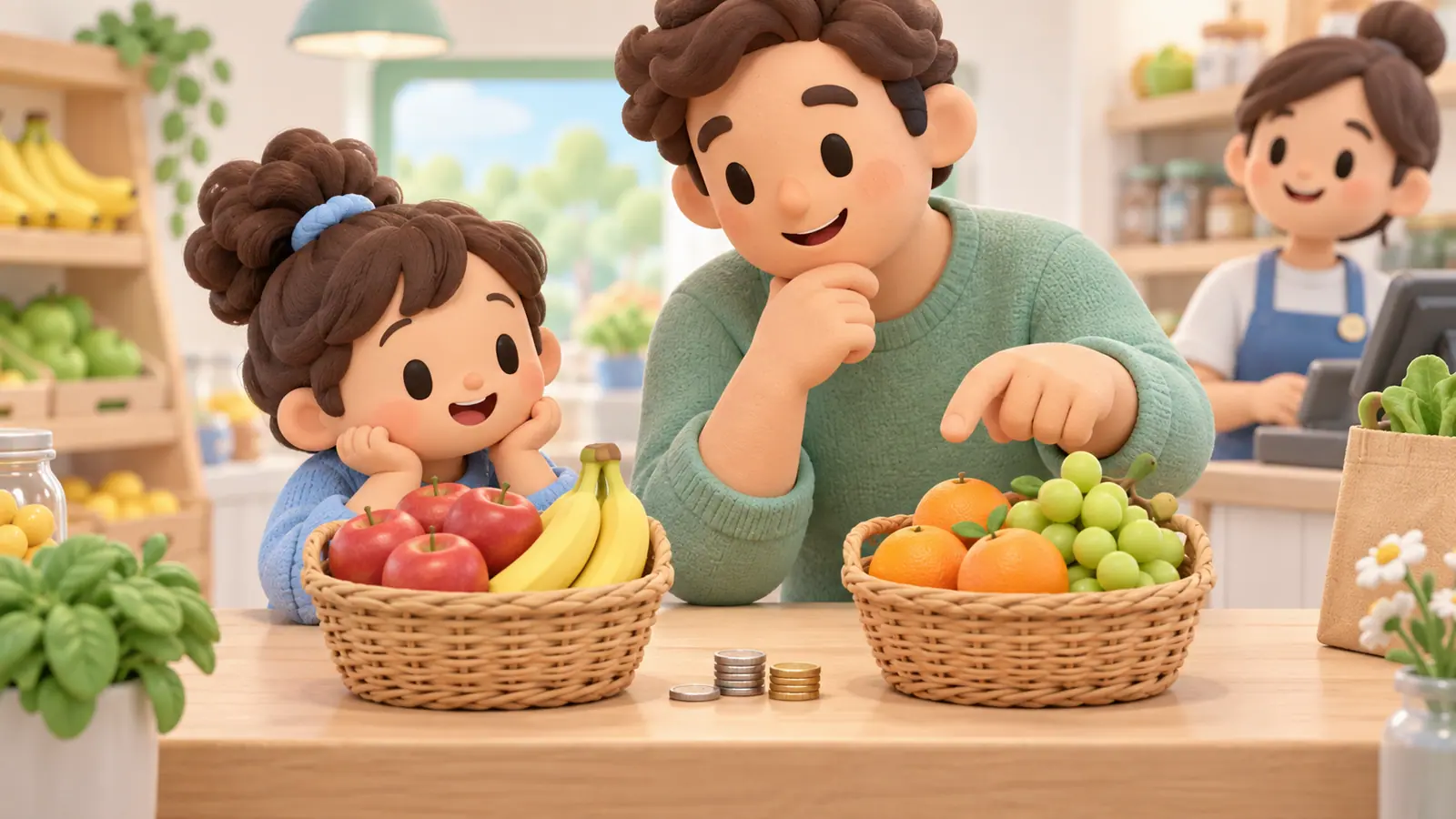
Grocery store math works best when it helps with one small shopping decision. Ask your child to estimate a total, count what the list needs, or compare two clearly labeled packages. You do not need to turn the entire trip into a lesson or buy something extra for the activity.
Use pretend prices at home if the store is busy. The examples below are invented for practice; they are not current prices or purchasing recommendations.
1. Match quantities to the list
Your list needs six apples. You already have two at home. How many should go in the basket? Four.
For an earlier learner, draw six circles and cover two. For a child ready for multiplication, ask how many apples three bags of four would contain. Keep the handling of produce and the store's rules in adult hands.
2. Estimate before calculating
Pretend a loaf costs $2.90 and yogurt costs $4.10. Rounded to whole dollars, that is about $3 + $4 = $7. The exact total is also $7 in this example.
Try a second pair: $3.80 and $2.60. The estimate is about $7; the exact total is $6.40. Discuss why an estimate can be useful without being the checkout amount.
Real totals may include taxes, deposits, discounts, or other adjustments. Let the actual receipt settle the real purchase.
3. Calculate change with pretend money
An item costs $6.35 and the pretend payment is $10. Count up: 65 cents reaches $7, then $3 reaches $10. The change is $3.65.
Write the same relationship as $10 − $6.35 = $3.65. Using dollars and cents consistently matters more than finishing quickly. If decimals are new, begin with whole-dollar examples.
4. Compare the same unit
Suppose 500 g of oats costs $2.50 and 1 kg costs $4.50. The smaller package costs $5 per kilogram; the larger costs $4.50 per kilogram.
The larger package has the lower unit price, but that does not automatically make it the better household choice. Storage space, what the family can afford today, and whether the food will be used all matter.
Only compare equivalent units. A price per ounce and a price per package cannot be compared directly without another calculation.
5. Scale a recipe
A recipe uses two cups of oats. How much would half the recipe need? One cup. How much would two batches need? Four cups.
Use a recipe your family already knows. Keep food allergies, kitchen safety, and actual ingredient preparation separate from the arithmetic exercise.
6. Check a receipt together
Choose one line and match it to an item. Ask what the quantity and price refer to. If the price differs from a shelf label, an adult can politely ask the store to explain. The child does not need to handle a dispute.
Make the activity fit the day
Pick one question before entering the store and stop when it is answered. If the child is tired or the shopping is urgent, save the lesson. A receipt at the kitchen table gives you the same numbers without the pressure of a checkout line.
For other low-preparation options, see our screen-free activity guide. If money math becomes a recurring practice task, use the manageable-task approach and keep real shopping privileges separate from getting every answer right.
Sources
We identify organizations and evidence types so readers can evaluate each claim. See our editorial policy.
- screen-free activity guide — OMO Kids Editorial Team. Editorial guide.
- manageable-task approach — OMO Kids Editorial Team. Editorial guide.