Learning
Map Reading for Kids: Build a Mini Map of Your Home
Teach map symbols, routes, grids, and scale with a simple room map. Includes an original map challenge and ways to make the activity easier or harder.
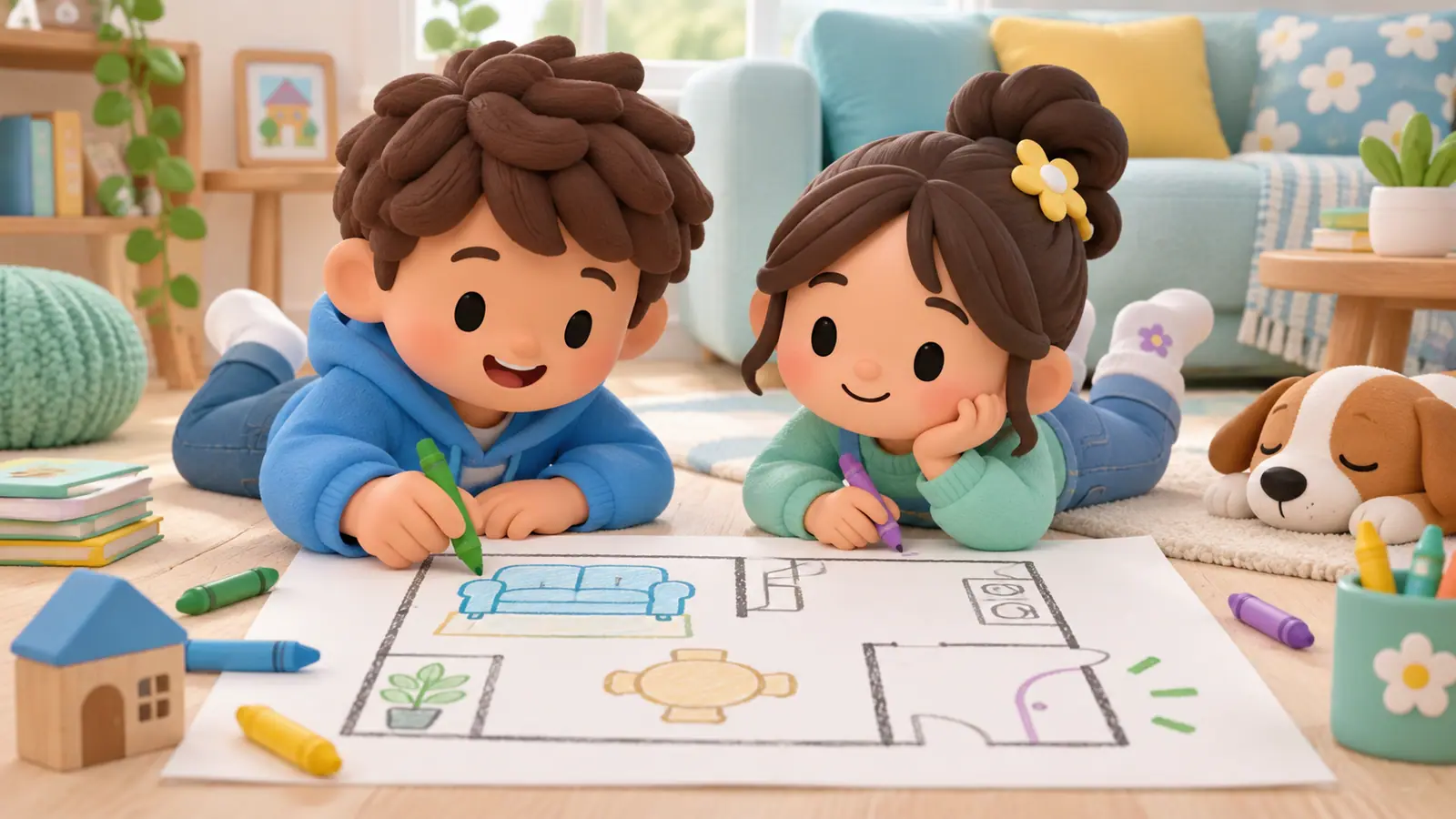
Map reading for kids can begin with a familiar room. Draw its main features from above, create a few symbols, and use the drawing to describe a route. The activity connects a real place with a representation of that place.
You need paper, a pencil, and a room you can move around safely. Keep private home maps offline; they do not need to show your address or be posted publicly.
Draw from above
Sketch the room as a rectangle or another approximate shape. Add the doorway, a table, and a window. Explain that the map shows where things are from above, not what they look like when you stand in front of them.
Let your child walk to the door, then point to the door on the drawing. Repeat with two other landmarks. If the map is confusing, use fewer objects and rotate the paper to match the child's view.
Give symbols a key
Choose a small rectangle for a table, a gap for a doorway, and a line along the wall for a window. Put those symbols in a key beside the map.
Ask why every table should use the same symbol. The point is that another person can interpret the map without guessing what each drawing means. A beautiful symbol that nobody can identify is less useful than a plain, consistent one.
Try a route challenge
Describe a route from the door to the table, then to the window. Have your child trace it before walking it. Switch roles and let the child guide you.
When giving directions, specify the reference point. “Turn left” depends on which way someone is facing. “Move toward the window” may be clearer on a first attempt.
Do not introduce compass directions by assuming that the top of the paper is geographically north. If you add north, establish the actual direction and label it accurately.
Add a simple grid
On a new drawing, make three columns labeled A, B, C and three rows labeled 1, 2, 3. Put the door in A1, the table in B2, and the window in C3. Ask your child to locate each square.
Then give a clue: “The object is in column B and row 2.” The answer is the table. This convention identifies a grid square; it is not the same as plotting exact coordinates on a mathematical graph.
Discuss scale with a toy room
For a more advanced activity, invent a rectangular room 4 meters by 3 meters. Draw it using 1 centimeter for each meter. The drawing should be 4 centimeters by 3 centimeters.
A toy table 1 meter long would be represented by 1 centimeter. If the table is drawn 3 centimeters long, it will appear much larger relative to the room. Ask what decision that mistaken map might lead someone to make.
End with a map someone else can use
Give the drawing to another family member and ask them to locate one object. Let your child revise anything unclear. Usability is a better finish line than filling every space with decoration.
For more low-preparation projects, see screen-free activities. If map practice becomes part of a short learning-before-gaming routine, choose one small challenge and honor its endpoint.
Sources
We identify organizations and evidence types so readers can evaluate each claim. See our editorial policy.
- screen-free activities — OMO Kids Editorial Team. Editorial guide.
- learning-before-gaming routine — OMO Kids Editorial Team. Editorial guide.