Learning
Multiplication Practice Without Timed Tests: Five Games to Try
Help your child practice multiplication with arrays, missing numbers, and five simple games. Includes worked examples, answers, and ways to adjust difficulty.
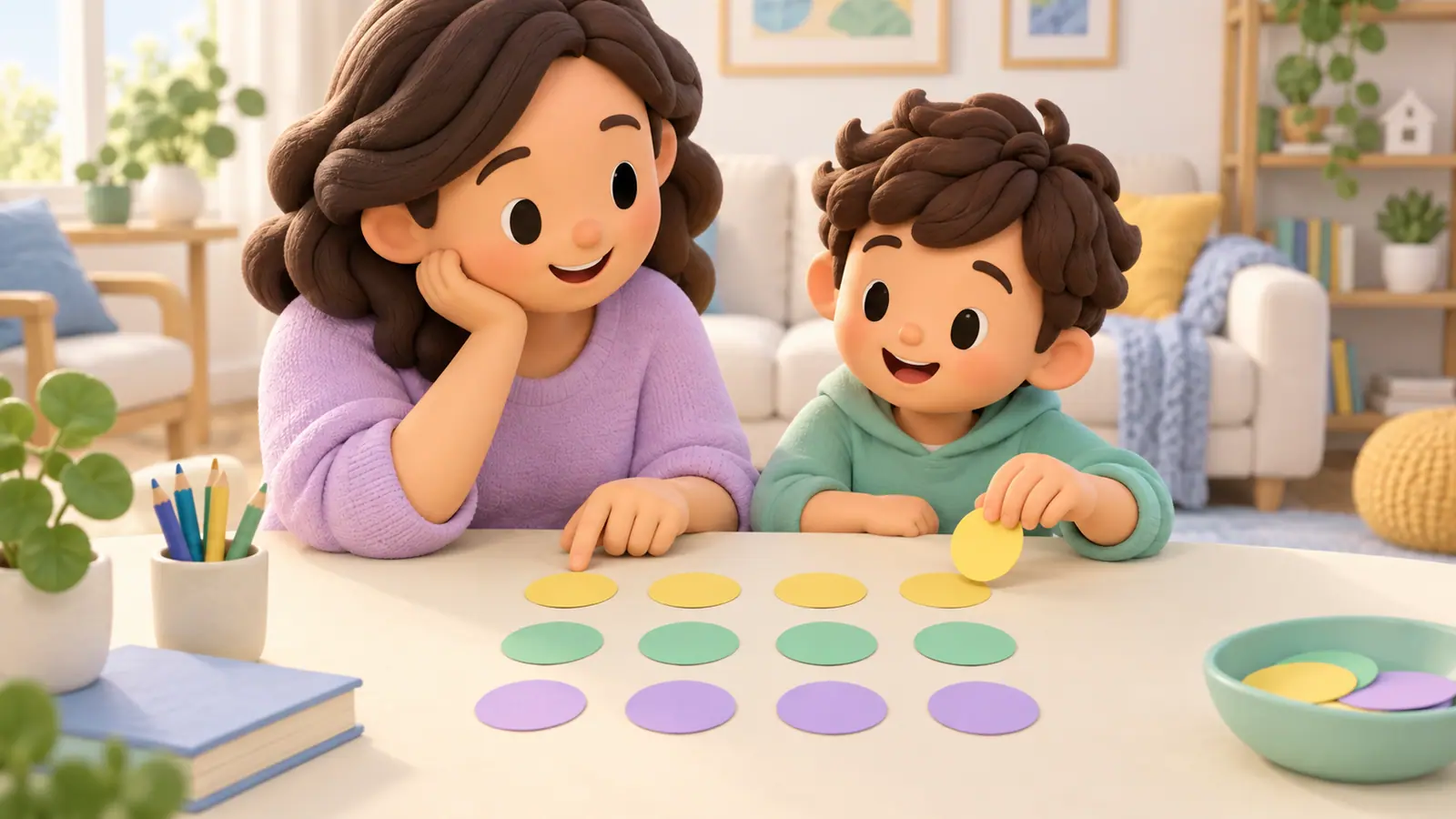
Multiplication practice without timed tests can focus on understanding equal groups, connecting familiar facts, and explaining a strategy. You need paper and a few objects, not a speed leaderboard. Start with facts your child has already met at school and choose one of the activities below.
Getting an answer quickly is one kind of performance. Being able to show why it works gives you different information. A child who pauses to draw four groups of six is still doing useful mathematical work.
Start with an array you can change
Draw three rows with four dots in each row. Ask, “How many dots are there? How could we count them without starting at one?” Accept counting in fours, adding four three times, or recognizing twelve.
Turn the paper. Now there are four rows of three. The total has not changed. Write both multiplication sentences beside the same picture: 3 × 4 = 12 and 4 × 3 = 12.
Keep the objects large enough for the child to handle safely. Paper dots work just as well as counters and do not create a cleanup job.
Five short multiplication games
- Build my rectangle. Say “Make 18 using equal rows.” Your child might draw three rows of six or two rows of nine. Ask whether there is another arrangement.
- Hide one row. Draw five rows of four, then cover one row. If five fours make 20, four fours make 16. Uncover the row to check.
- Near a known fact. Start from 5 × 7 = 35. Ask for 6 × 7. One more group of seven gives 42.
- Find the missing group. Write 4 × □ = 24. Let your child draw or group objects before naming six.
- Be the checker. Write the deliberate mistake 3 × 8 = 21. Ask the child to show a convincing correction, rather than simply saying it is wrong.
Choose one game per sitting. These are original practice ideas, not a sequence every child must complete.
A sample round with answers
| Prompt | Answer | One possible explanation |
|---|---|---|
| Four bags hold three shells each. How many shells? | 12 | 3 + 3 + 3 + 3 |
| You know 5 × 6 = 30. What is 4 × 6? | 24 | Remove one group of six |
| Draw two different arrays for 12. | 3 × 4 and 2 × 6 | Both contain twelve dots |
| What belongs in 7 × □ = 21? | 3 | Three sevens make 21 |
If your child gives a different valid method, keep it. The purpose is to connect the question, representation, and answer.
When practice becomes frustrating
Change the task before adding more repetitions. Use smaller quantities, draw the groups together, or provide a starting fact. If the child can build the groups but cannot read the written question, read it aloud and keep the mathematical goal unchanged.
Finish after the agreed small set. Do not turn an easy round into an unexpected second assignment. Next time, revisit one familiar fact and introduce one new connection.
Persistent difficulty is worth discussing with the teacher using an example of the child's work. “They can make equal groups but lose track when counting” is more useful than “They are bad at times tables.”
If your family uses learning before gaming
Keep the practice endpoint separate from the entertainment limit. Three agreed questions should not become an unlimited contest for more minutes. Our guide to choosing learning tasks before gaming explains that boundary. For digital practice, use the educational app checklist to inspect feedback after mistakes.
Sources
We identify organizations and evidence types so readers can evaluate each claim. See our editorial policy.
- choosing learning tasks before gaming — OMO Kids Editorial Team. Editorial guide.
- educational app checklist — OMO Kids Editorial Team. Editorial guide.