Learning
Mental Addition for Kids: Three Strategies Beyond Counting by Ones
Practice mental addition through making ten, using doubles, and breaking numbers apart. Find worked examples and a short answer key for home practice.
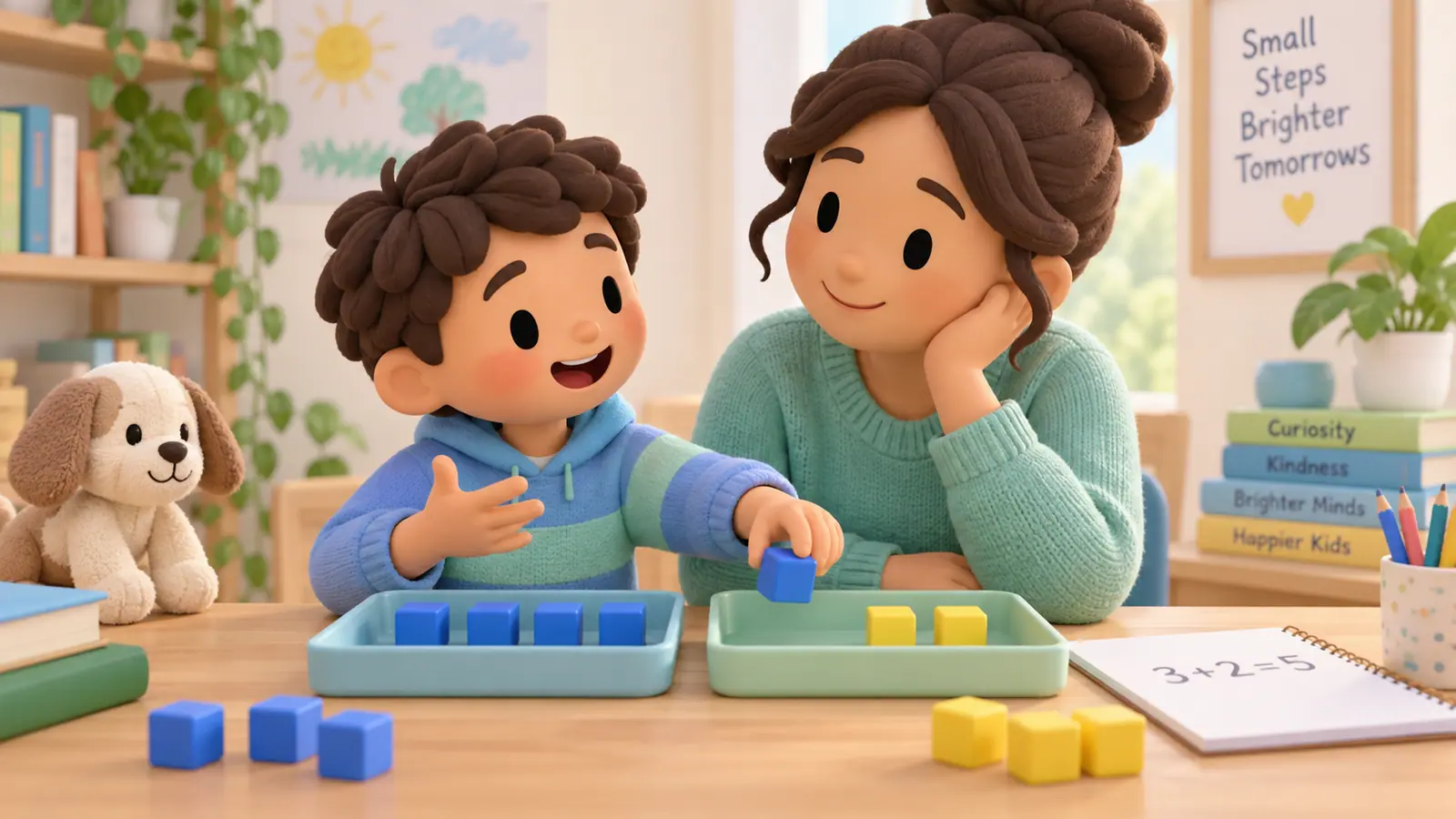
Mental addition does not mean answering instantly or refusing to use paper. It means choosing a useful way to combine numbers. Three practical starting strategies are making ten, using a familiar double, and breaking numbers into parts.
Try these after your child has encountered the underlying ideas at school. If they still need objects to represent the numbers, use them. You can discuss a mental strategy while keeping the quantities visible.
Strategy 1: Make ten
For 8 + 5, ask how many more eight needs to reach ten. The answer is two. Split five into two and three:
8 + 5 = 8 + 2 + 3 = 10 + 3 = 13.
Draw eight dots in a ten-frame or make a row with two empty places. Move two of the extra five dots into those spaces. The remaining three are easier to see beside a complete ten.
The useful question is “How did you split the five?” If the child says “I moved five to ten,” return to the actual objects. A strategy name is not evidence that the quantity stayed the same.
Strategy 2: Use a double you already know
If your child knows 6 + 6 = 12, then 6 + 7 is one more: 13. Likewise, 9 + 8 is one less than 9 + 9, giving 17.
Draw two rows of six, then add one object to a row. Ask what changed and what stayed the same. You do not need a separate memorized rule for every near-double.
Use a familiar double. A child who does not yet know 8 + 8 gains little from being told to use it as an anchor.
Strategy 3: Break numbers into tens and ones
For 27 + 15, one option is 27 + 10 + 5. That gives 37 + 5 = 42. Another is 20 + 10 + 7 + 5, or 30 + 12.
Both are valid. Ask which felt easier and why. A child may prefer a different method depending on the numbers. The goal is a useful choice, not loyalty to the strategy an adult demonstrated first.
A six-question practice set
| Question | Answer | A possible route |
|---|---|---|
| 9 + 4 | 13 | 9 + 1 + 3 |
| 7 + 5 | 12 | 7 + 3 + 2 |
| 5 + 6 | 11 | Double 5, then add 1 |
| 8 + 9 | 17 | Double 8, then add 1 |
| 24 + 13 | 37 | 24 + 10 + 3 |
| 36 + 18 | 54 | 36 + 10 + 8 |
Choose two questions, not necessarily all six. Ask your child to explain one and let the other be an independent attempt. Read the question aloud if reading is getting in the way of arithmetic.
What to do with a wrong answer
Listen for the exact step where the numbers changed. For 8 + 5, a child might correctly make ten but forget that only three remain. Rebuild that step. Repeating “Think harder” does not reveal the missing relationship.
End by writing one strategy in the child's words, such as “I filled ten, then added what was left.” Bring it back another day with different numbers.
If your family connects practice with entertainment, agree on the task in advance. Keep any learning-to-access arrangement separate from speed or perfect performance.
Sources
We identify organizations and evidence types so readers can evaluate each claim. See our editorial policy.
- agree on the task in advance — OMO Kids Editorial Team. Editorial guide.
- learning-to-access arrangement — OMO Kids Editorial Team. Editorial guide.