Learning
How to Help Kids With Math Word Problems Without Giving the Answer
Help your child solve math word problems with a read, represent, solve, and check routine. Includes original examples, answers, and useful parent prompts.
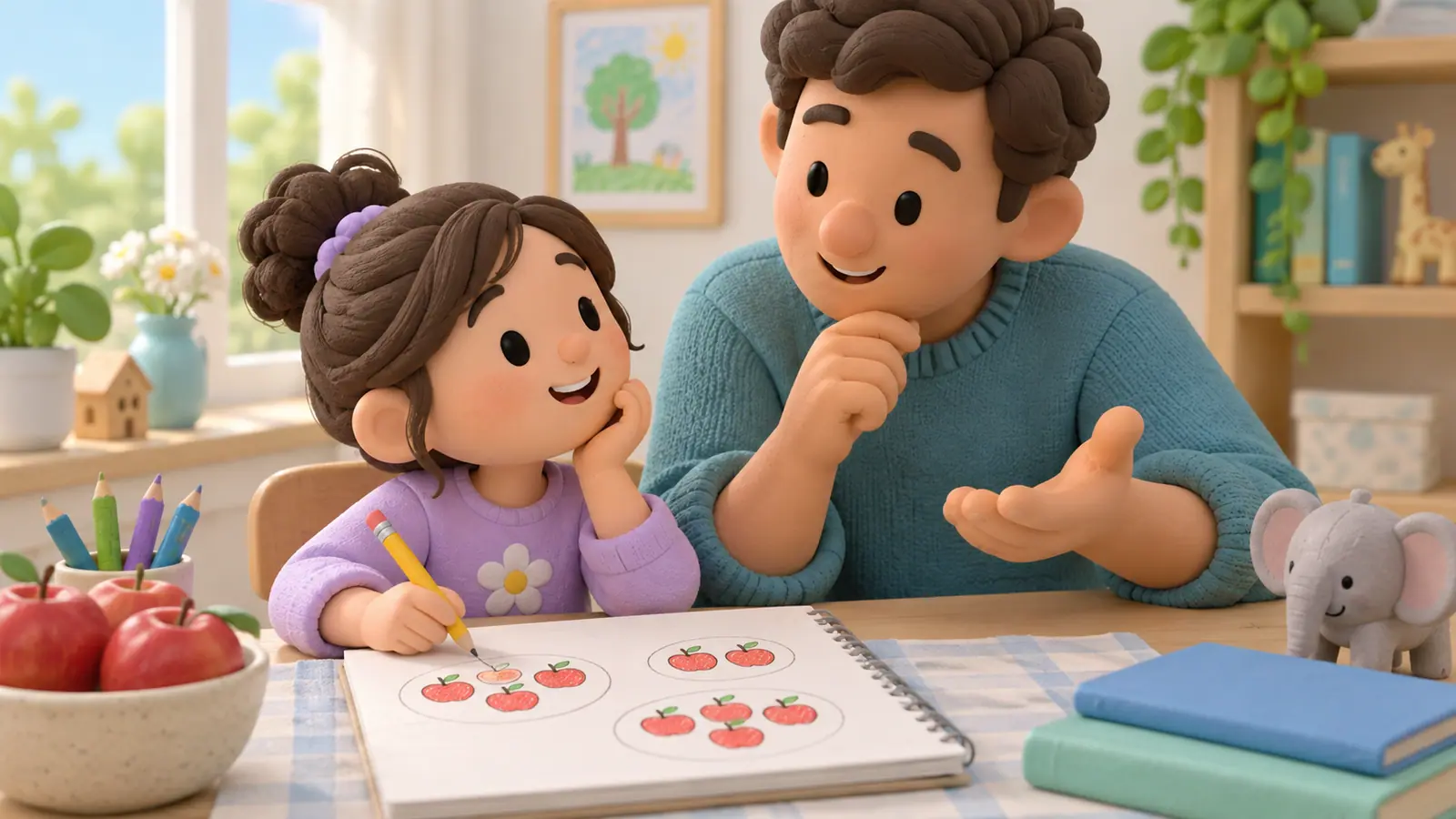
When a child is stuck on a math word problem, first find out whether the difficulty is reading the situation, representing it, choosing an operation, or doing the calculation. Those are different problems. Solving the arithmetic for them may leave the actual obstacle untouched.
Use a short routine: read the situation, represent what is happening, solve, and check the answer against the story. There is no need to rush through all four steps.
Read for the situation, not a magic keyword
Try this original problem: “Maya has 14 stickers. She has 6 more stickers than Leo. How many stickers does Leo have?”
The word “more” appears, but adding 14 and 6 would answer the wrong question. Ask your child who has the larger collection. Maya does. Leo must have fewer than 14.
If the reading is difficult, read the sentence aloud. Then ask the child to explain the situation in ordinary words. This lets you separate reading demands from the mathematical relationship.
Represent the relationship
Draw a bar for Maya's 14 stickers. Beneath it, draw a shorter bar for Leo and mark the difference as six. Now the question is visible: what amount plus six makes fourteen?
Your child can subtract 6 from 14 or count up from 6 to 14. The answer is 8 stickers. Ask whether 8 fits the story: Maya's 14 is indeed six more than Leo's 8.
A representation can be a drawing, objects, a number line, or a short equation. It should clarify the situation. Decorative pictures that do not show the relationship add work without helping much.
Practice with three different structures
| Story | Equation | Answer |
|---|---|---|
| Four boxes hold six pencils each. How many pencils altogether? | 4 × 6 | 24 pencils |
| There were 19 passengers. Seven left the bus. How many remain? | 19 − 7 | 12 passengers |
| A ribbon is 30 cm long. Nine cm is cut off, then another 8 cm. What remains? | 30 − 9 − 8 | 13 cm |
For the ribbon problem, let the child draw the whole ribbon and cross out both pieces. If they stop after the first subtraction, ask what happened next in the story.
Prompts that leave the thinking with your child
- “What are we trying to find?”
- “What do we know already?”
- “Can you show that with a picture?”
- “Should the answer be bigger or smaller than this number?”
- “What does the number in your answer stand for?”
Avoid stacking five questions at once. Offer one prompt, then leave space for a response. If it does not help, demonstrate a simpler example with different numbers before returning to the original.
When to stop helping
If you are choosing every operation and supplying each next step, the child is no longer doing an independent homework attempt. Make a short note for the teacher: “Could describe the story; needed help representing the comparison.” That is useful information, not a failed evening.
Keep the homework finish line realistic using our after-school routine guide. If you later use word problems as a short practice task, choose a familiar skill and allow help. A new, confusing concept should not become a barrier to every planned break.
Sources
We identify organizations and evidence types so readers can evaluate each claim. See our editorial policy.
- after-school routine guide — OMO Kids Editorial Team. Editorial guide.
- choose a familiar skill and allow help — OMO Kids Editorial Team. Editorial guide.