Learning
Observation vs Inference for Kids: A Simple Science Conversation
Help children distinguish what they observe from what they infer. Includes everyday examples, an original mystery, and a simple evidence record.
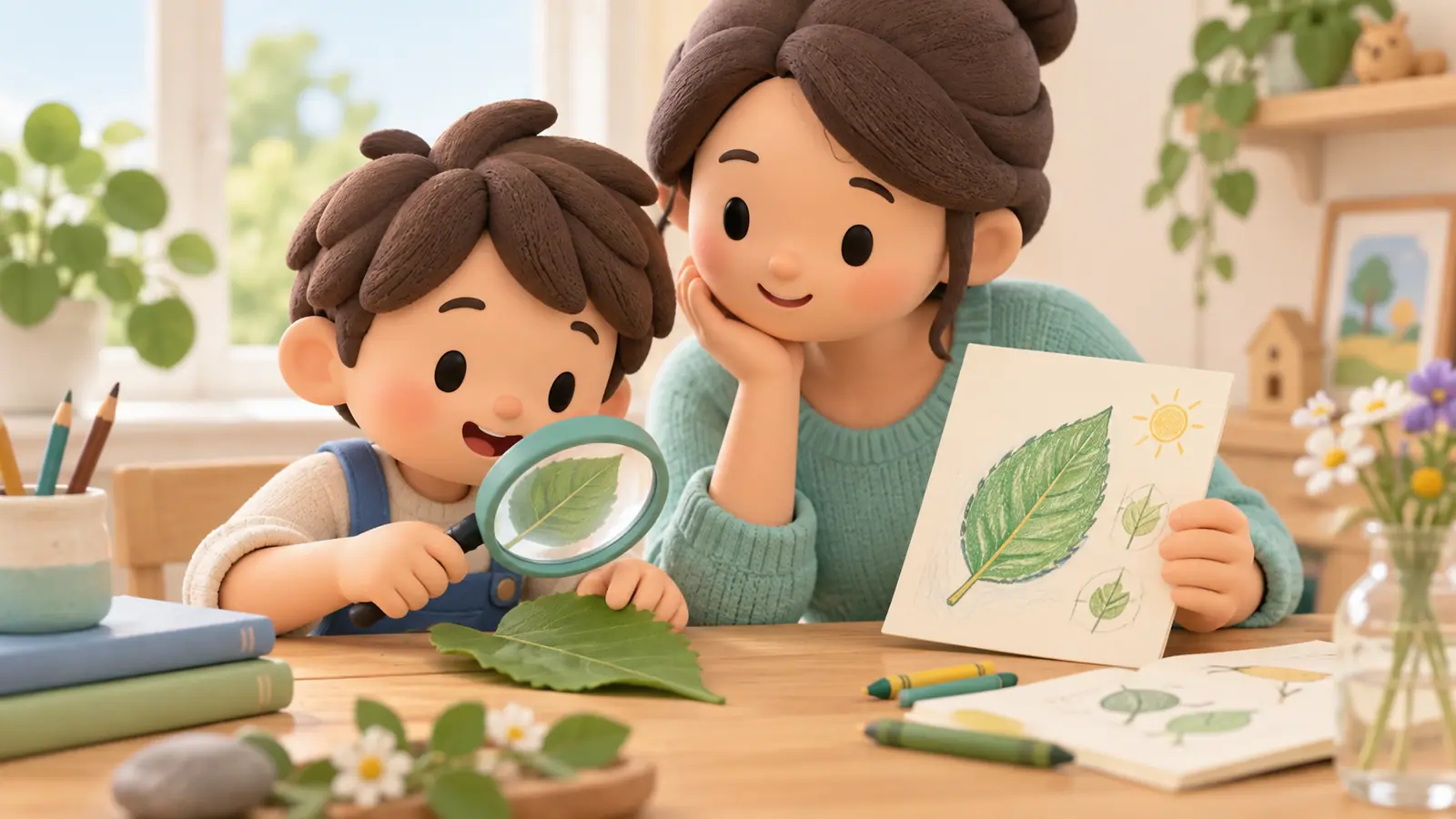
An observation describes information you directly notice or measure. An inference is an explanation you draw from information. Children can practice the difference with an ordinary scene, without special equipment or a dramatic experiment.
For example, “The pavement is wet” is an observation. “It rained” is an inference. Rain may explain the water, but a sprinkler or someone washing the path could also be responsible.
Start with a low-stakes mystery
Imagine a houseplant beside a window. Several leaves are bent toward the window, and the soil surface looks dry. Ask your child to make two lists: what we can observe and what we think might explain it.
“Three leaves point toward the window” belongs in the observation list. “The plant is looking for light” is an interpretation, and “It has not been watered for a week” is not established by appearance alone.
You do not need to settle the plant's condition during this activity. The goal is to keep the description separate from the explanation.
Use an evidence record
| What I noticed | One possible explanation | What else could explain it? | What could I check? |
|---|---|---|---|
| A wet patch under a bottle | The bottle leaked | Someone spilled water nearby | Dry the area and inspect the closed bottle with an adult |
| A toy is not where it was | Someone moved it | I remember the location incorrectly | Ask others and check nearby places |
| A paper plane turned left | One wing was uneven | The throw or air movement changed | Compare several careful throws |
These are invented examples. Do not turn a missing object into an accusation against a sibling. An inference is a possibility to examine, not permission to blame someone.
Ask what would change your mind
If your child thinks the bottle leaked, ask what finding would make that explanation less likely. A dry bottle that remains dry after a careful check is useful information. It does not prove that the bottle could never leak under any conditions.
Model the same habit yourself: “I thought the window was open because the curtain moved. Now I can see the fan is on.” Changing an explanation after finding new evidence is part of reasoning.
Keep a test focused
For a paper-plane comparison, use the same starting place and a similar throw. Change one feature at a time if you want to investigate that feature. Repeat the attempt because one throw may be unusual.
Keep the activity indoors in a clear space and away from faces or fragile items. If there is no suitable space, discuss drawings of possible results instead.
Carry the distinction into online life
A clip showing someone running does not by itself establish why they ran. A screenshot of a number does not explain how the number was measured. Ask, “What can we actually see, and what is the caption adding?”
This does not mean every explanation is equally plausible. Some have stronger supporting evidence. The habit is to identify the evidence before committing to the story.
Our digital citizenship guide offers related conversations about credibility. For a short home activity, use the learning-task guide to keep the endpoint clear: a few observations and one question to investigate can be enough.
Sources
We identify organizations and evidence types so readers can evaluate each claim. See our editorial policy.
- digital citizenship guide — OMO Kids Editorial Team. Editorial guide.
- learning-task guide — OMO Kids Editorial Team. Editorial guide.