Family Rules
How to Play Video Games With Your Child Without Taking Over
Plan a shared gaming session where your child can teach and everyone participates. Includes useful questions, role choices, and a clear stopping point.
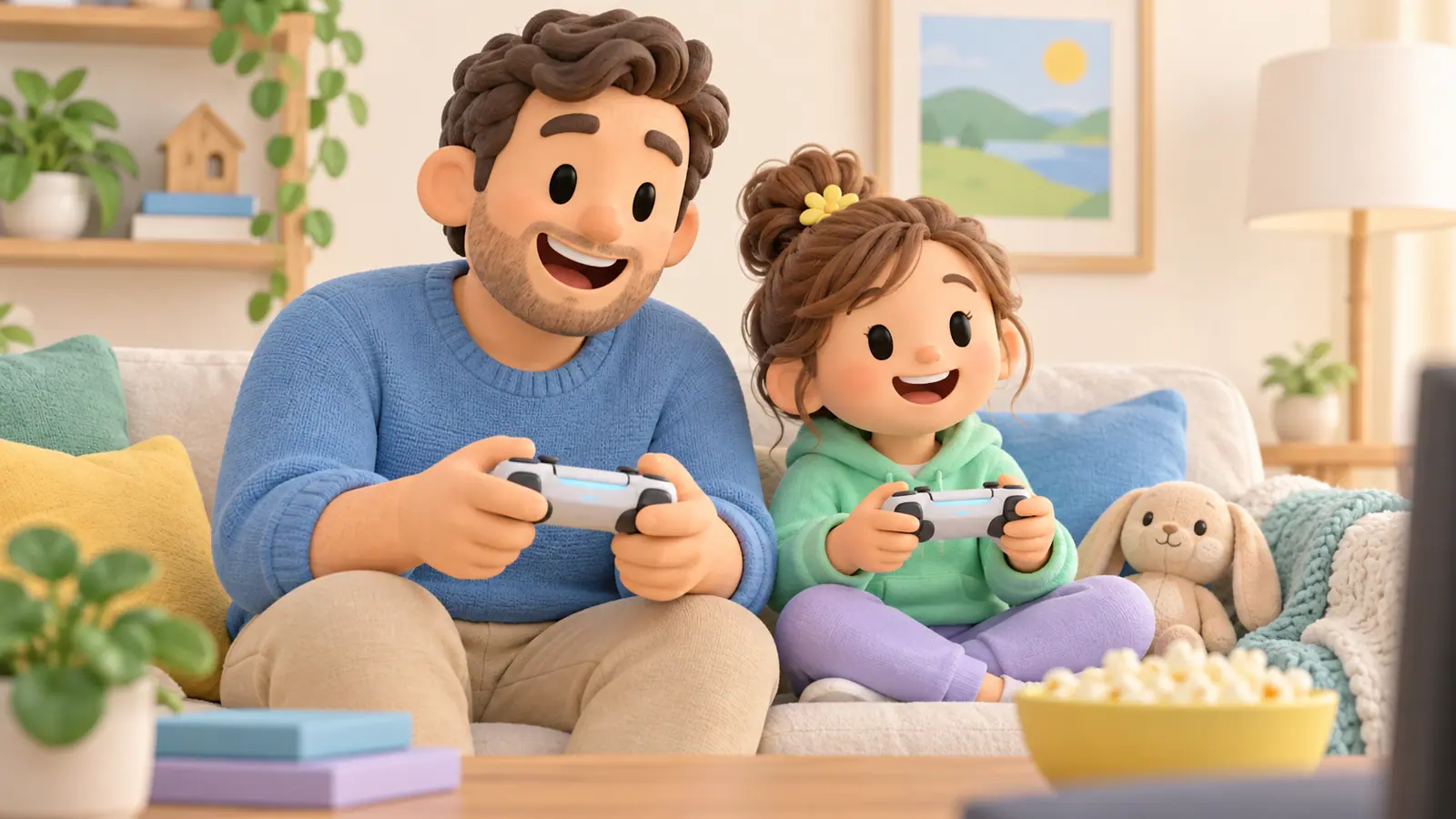
Playing a video game with your child can be a way to understand an activity they care about. Ask them to show you one manageable part rather than expecting a tour of everything they have built or learned. Your first job is to participate, not to prove you can master the controls faster.
Choose a game and mode that fit the family, then agree on a session that has a clear endpoint.
Let the child choose a teachable starting point
Ask, “What could we do together that would make sense to a beginner?” A short building task or a simple cooperative objective may be easier than entering a competitive match where other players depend on you.
Give the child permission to explain the controls slowly. If they take the controller to demonstrate, ask for it back when you are ready to try. Watching a demonstration and doing the action are different forms of participation.
Decide who does what
| Shared activity | Possible roles | What to avoid |
|---|---|---|
| Build a small structure | One plans; one places pieces; then swap | Adult redesigns everything |
| Solve a puzzle | One reads clues; one tests an idea | One person supplies every answer |
| Explore a world | Child guides; adult asks about choices | Turning the session into constant safety questions |
| Play a cooperative round | Each has an achievable role | Entering a mode neither person can manage |
The activity does not have to be equal in difficulty to be shared. It does need a meaningful role for both people.
Ask questions during natural pauses
Try “What made you choose that route?” or “What is the part you enjoy most?” These questions invite the child to explain the experience without having to defend it.
Save detailed concerns for a calmer moment after the session. If something unsafe appears, pause immediately, but ordinary curiosity does not need to become an interrogation about every button.
Notice the social setting as well. Are the other players known friends? Does a public chat appear? Are there purchase prompts? You are learning what this session contains, not assuming every game works the same way.
Model an ordinary mistake
If you lose or misunderstand a rule, say what happened without blaming the child. “I started before I knew the jump button” is a more useful response than declaring the game unfair.
Let the child make mistakes too. A shared session should not turn into a coaching performance unless they asked for that help.
Make stopping part of the plan
Before play, agree on when the last new round can begin and what you will do afterward. Ask how saving works so a preventable loss of progress does not complicate the ending.
Do not offer unlimited extra play because the session felt positive. Enjoying an activity together and keeping the agreed endpoint can both happen.
Use what you learned
Afterward, name something specific you now understand: the effort in building, the appeal of teamwork, or why one kind of round is hard to interrupt. That information can improve the next family agreement.
The FTC's video game guidance encourages discussing actual game experiences and expectations. For broader context, see our gaming hobby guide and game chat safety conversations.
Sources
We identify organizations and evidence types so readers can evaluate each claim. See our editorial policy.
- video game guidance — Federal Trade Commission. Source guidance.