Digital Wellbeing
Problematic Smartphone Use in Children: What Parents Can Observe
Look at control, context, and everyday functioning. This guide includes a family observation journal, not a diagnostic score.
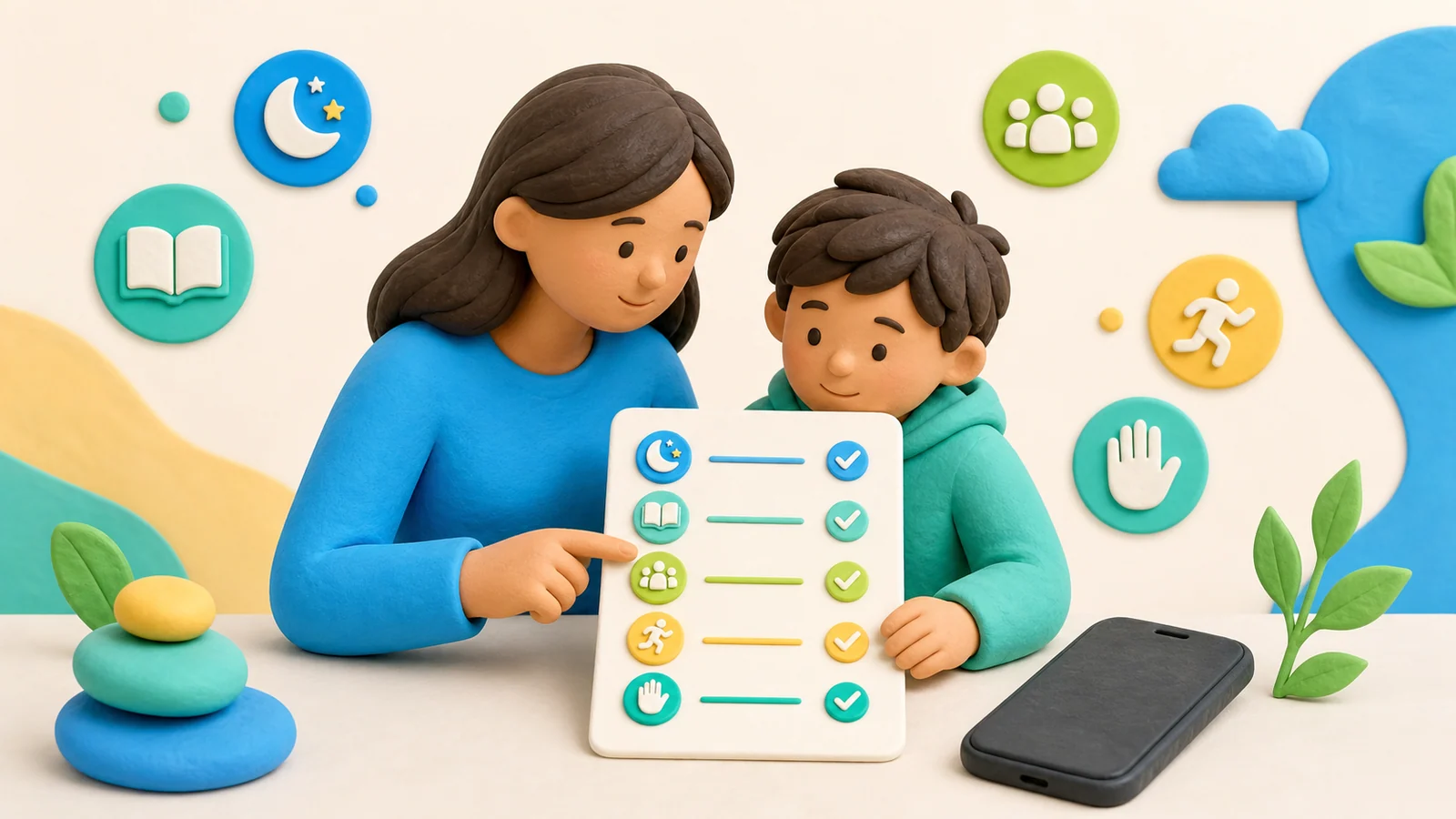
A high screen-time total does not tell you whether a child has a disorder. Start with what is happening in everyday life: sleep, school, relationships, safety, and the child's ability to move between activities. Repeated difficulties deserve attention even when you do not have a diagnostic label.
Parents searching for “screen addiction” or “digital addiction in children” are often asking something more immediate: “Why can't we end this session?” or “How do I know when to get help?” This guide helps you describe the problem and take a next step. It is not a diagnostic test.
What the terms can—and cannot—tell you
Researchers use problematic smartphone use to describe patterns assessed with different questionnaires and definitions. A 2019 review linked these patterns with mental-health difficulties, but most included studies measured people at one time. Its population also included young adults; the results cannot simply be read as a percentage of American children who are “addicted.” The findings do not settle cause and effect. Sohn et al., systematic review.
Gaming has its own clinical and research frameworks. The American Psychiatric Association's proposed Internet Gaming Disorder category concerns gaming, not all smartphone use. Do not use a gaming checklist to label homework, messaging, or every difficult phone habit. APA explanation.
Separate the phone from what it provides
Ask your child to walk you through an ordinary session. Is it conversation with friends, a school assignment, a competitive game, music, or a feed that keeps offering another video? Check whether several things run together, making the total look like one activity.
Then ask what comes before the longest sessions. Is the child avoiding a hard assignment, waiting for friends, feeling lonely, or simply following a familiar routine? These are questions to explore, not conclusions to draw from the phone alone.
An illustrative opening: “I've noticed bedtime has become harder this week. Can you show me what happens online at that time? I want us to work out a plan that protects sleep and still leaves room for your friends.”
A private observation journal with no score
Use paper or a private document you control. Do not include names, private messages, photographs, or account details. You do not need to upload the journal to OMO or any website.
| What to note | Your entry |
|---|---|
| Day and situation | __________ |
| Activity and its purpose | __________ |
| What happened just before use | __________ |
| The agreed stopping cue, if there was one | __________ |
| What happened at the transition | __________ |
| Effect on sleep, schoolwork, meals, relationships, or safety | __________ |
| What the child said mattered | __________ |
| What helped, including a successful transition | __________ |
Make brief notes over several ordinary days. No number of filled boxes proves addiction. The journal is an editorial conversation aid, not a validated screening tool. If serious concerns are already present, seek help without waiting to finish it.
For example: “Tuesday: chat about tomorrow's group project; stopped after sending the last message; no missed routine.” Another entry might be: “Thursday: videos after getting into bed; slept later than planned; child said they lost track.” Both examples are fictional and illustrate what an observation looks like.
Try one change tied to the actual difficulty
If entertainment is extending into bedtime, agree on where the device charges and how necessary contact remains available. If the difficult moment is the end of a game, agree on the endpoint before play. If notifications interrupt homework, decide which are essential and silence the rest where the device permits it.
Include a replacement that fits the reason for use. Removing a social activity without discussing another way to connect can leave the original need unresolved. Keep exceptions visible: a school task, a family call, and an accessibility function may require different treatment from entertainment.
Use the family media plan to write a manageable agreement. The AAP recommends a plan tailored to the household and revisited as children and circumstances change. AAP family media guidance.
Questions parents often ask
“Does anger when I take the phone mean withdrawal?” A difficult transition alone does not establish that. Note what happened, how long the difficulty lasted, and whether the pattern extends beyond stopping one enjoyable activity. Our transition guide offers conversation examples.
“Should I ban everything immediately?” A single rule is unlikely to fit homework, friendships, entertainment, and necessary communication equally well. Address an immediate safety concern promptly; for everyday problems, identify what needs to change and explain it.
“Can an app solve the underlying issue?” A limit can support an agreement. It cannot assess depression, anxiety, bullying, learning difficulties, or family stress. Those may require a different kind of support.
When to involve a professional
Contact the child's pediatrician or a qualified mental-health professional when difficulties are persistent, substantially disrupt daily life, or involve marked changes in mood, sleep, school attendance, relationships, or safety. The AAP advises seeking support when trouble with screen transitions accompanies broader concerns. AAP guidance.
Bring examples, the child's perspective, and changes you have tried. Ask for an assessment of the whole situation rather than confirmation of a label. If someone is in immediate danger, seek emergency help promptly.
OMO Kids can be considered as a family tool for educational tasks before timed access to selected apps. It is not a diagnostic or treatment service. Read its device and family setup requirements before deciding whether that particular mechanism fits your family's plan.
Sources
We identify organizations and evidence types so readers can evaluate each claim. See our editorial policy.
- Prevalence of problematic smartphone usage and associated mental health outcomes amongst children and young people: a systematic review, meta-analysis and GRADE of the evidence — PubMed Central.
- Psychiatry.org - Internet Gaming — psychiatry.org.
- How to Make a Family Media Plan - HealthyChildren.org — American Academy of Pediatrics.
- Screen Time & Temper Tantrums: Helpful Tips for Parents - HealthyChildren.org — American Academy of Pediatrics.