Learning
Timeline Activities for Kids: Put Events in Order and Measure the Gaps
Build a simple timeline with your child using fictional town events. Practice chronology, intervals, and the difference between sequence and cause.
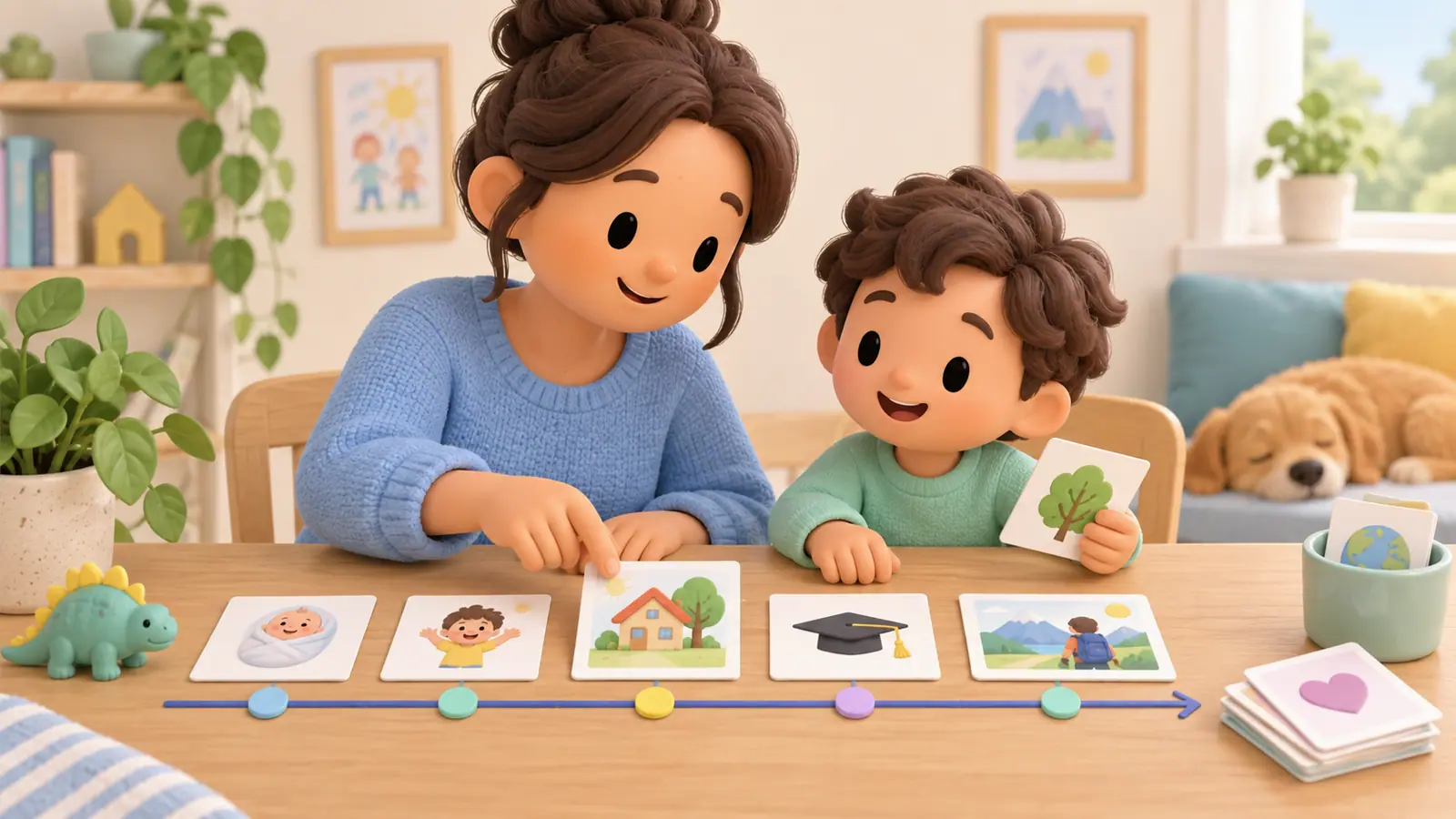
A timeline shows when events happened relative to one another. For children, the first useful steps are putting events in order, measuring the gaps, and noticing whether the drawing uses a consistent scale.
You can begin with a day's routine or a fictional town. A fictional example lets you focus on the timeline skill without also asking your child to memorize unfamiliar historical facts.
Use these invented town events
| Year | Event |
|---|---|
| 2000 | A library opened |
| 2005 | A bridge opened |
| 2015 | A playground opened |
| 2020 | The library added a new room |
Write each event on a separate card and mix the cards. Ask your child to put them from earliest to latest. Then ask which event happened between the bridge opening and the library extension. The answer is the playground opening.
The town and events are made up. Label them that way if you print or share the activity.
Build a scaled line
Draw a line from 2000 to 2020. Put a mark every five years, using equal distances between marks. The five-year gap from 2000 to 2005 should occupy the same space as the gap from 2015 to 2020.
Now place the event cards. There is a ten-year gap between the bridge and the playground, so those events should be twice as far apart as the library and bridge openings.
If you simply arrange cards at equal distances, you have shown sequence, but not proportional time gaps. Both formats can be useful as long as you explain which one you are using.
Ask questions that use the line
- How long after the library opened did the bridge open? Five years.
- How long was the interval between the bridge and playground openings? Ten years.
- Which two events were twenty years apart? The library opening and its new room.
- Did the playground open before or after the bridge? After.
- Does the timeline explain why the playground opened? No. It records when, not the cause.
That final distinction matters. An event happening after another event does not by itself show that the first caused the second.
Add an event between the marks
Invent a bus stop opening in 2012. Ask where it belongs between 2010 and 2015. If the line is scaled, it should appear two-fifths of the way across that interval.
For a younger child, placing it between the correct years is enough. For a child working with fractions, discuss the more precise position. Adapt the demand instead of treating every version of the activity as equally easy.
Move to a real topic carefully
Choose a small set of dates from a reliable book, museum, or official source. Record the source alongside the timeline. If an event happened over several years, represent the duration rather than forcing it into a single unexplained date.
Family timelines can also work, but do not require a child to share private or difficult events. An invented story is a valid alternative.
For more paper-based ideas, see screen-free activities. Our learning-task guide can help you choose whether today's goal is ordering four cards or interpreting the gaps; those are separate achievements.
Sources
We identify organizations and evidence types so readers can evaluate each claim. See our editorial policy.
- screen-free activities — OMO Kids Editorial Team. Editorial guide.
- learning-task guide — OMO Kids Editorial Team. Editorial guide.