Learning
Audiobooks, Ebooks, or Print: Choose by the Reading Task
Compare listening, screen reading, and print by the task your child needs to do. Includes an example using one story and questions for school assignments.
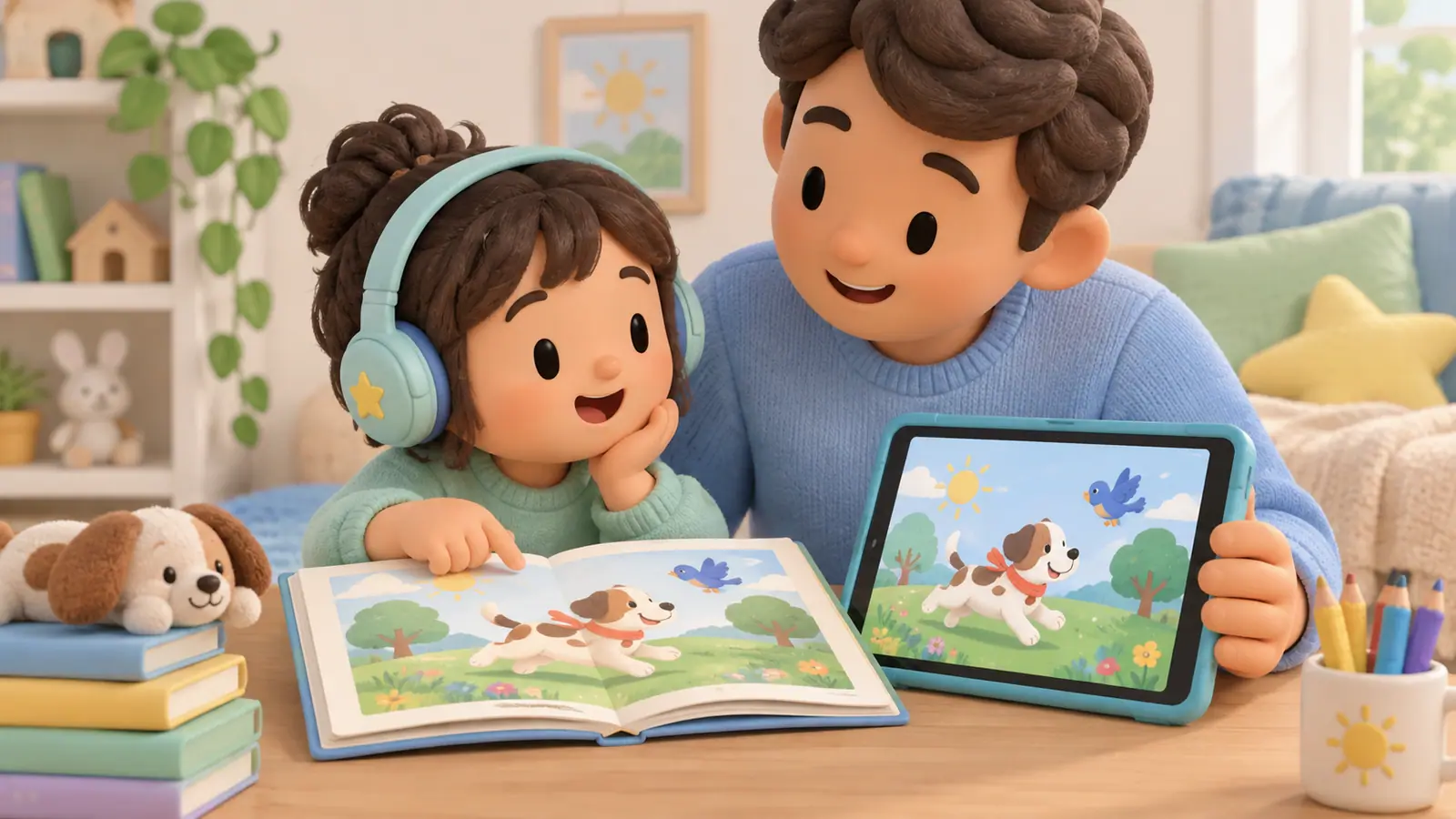
Audiobooks, ebooks, and print can each have a place in a child's reading life. Choose by the task: listening to a story, practicing word reading, finding a detail, or enjoying a book together. The same title in three formats does not create three identical learning activities.
If a school assignment requires a particular skill, ask the teacher which formats and supports fit. An accommodation already agreed with the school should not be removed because a general article favors another format.
Match the format to the purpose
| Purpose | A possible format | What to notice |
|---|---|---|
| Enjoy a story beyond current independent reading level | An adult read-aloud or audiobook | Whether the content is suitable and understandable |
| Practice decoding written words | A suitable print text or ebook | The child actually reads the words |
| Study a diagram or compare pages | Print or a well-designed digital layout | Whether labels and references are easy to find |
| Follow text while listening | A matching text and recording | Whether the child can keep their place comfortably |
| Read during travel | A prepared format the child can access | Battery, downloads, motion comfort, and the actual setting |
No row is a rule for every child. Accessibility, preference, and the available materials matter.
Try one story in two ways
Read a short passage aloud and ask the child to explain what happened. Later, offer a manageable passage for independent reading. If understanding is stronger when listening, the difference may help you describe the task to a teacher.
Do not treat this informal comparison as a diagnostic test. The passages, fatigue, familiarity, and adult support can all affect the result. Record what happened rather than assigning a label.
Look at the digital experience, not only the screen
An ebook might present a quiet page with adjustable text. Another might interrupt every paragraph with games, pop-ups, or unrelated animations. Inspect what your child actually encounters.
Check whether the text is legible, navigation is simple, and the child can return to a previous page. If reading aloud is available, decide whether it supports today's purpose. Do not disable a needed accessibility tool merely to make the task look more independent.
Give listening a clear endpoint
Choose a chapter or other understandable stopping point before pressing play. If the child wants to discuss a scene, pause. Listening does not have to become another continuous feed.
For headphones, check the real volume and listening duration rather than assuming a product label guarantees safety. Our headphone guide explains the setup questions in more detail.
Ask a better question than “Does it count?”
Ask what the activity is meant to count toward. Listening can count as enjoying a story or discussing its ideas. It does not show that the child independently decoded the printed words. Following an ebook can involve word reading, but time with the app alone does not prove comprehension.
Keep those distinctions in a school reading log. If the instructions are unclear, describe the format honestly and ask what the teacher wants recorded.
For choosing an app or digital book, use the educational app checklist. The useful decision is the match between the child, the content, and the task, not a competition between paper and a device.
Sources
We identify organizations and evidence types so readers can evaluate each claim. See our editorial policy.
- headphone guide — OMO Kids Editorial Team. Editorial guide.
- educational app checklist — OMO Kids Editorial Team. Editorial guide.