Learning
Writing Prompts for Kids Who Love Games: Build a Story From a Quest
Use gaming interests for original stories, instructions, and persuasive writing. Includes ten prompts, a worked opening, and a simple revision checklist.
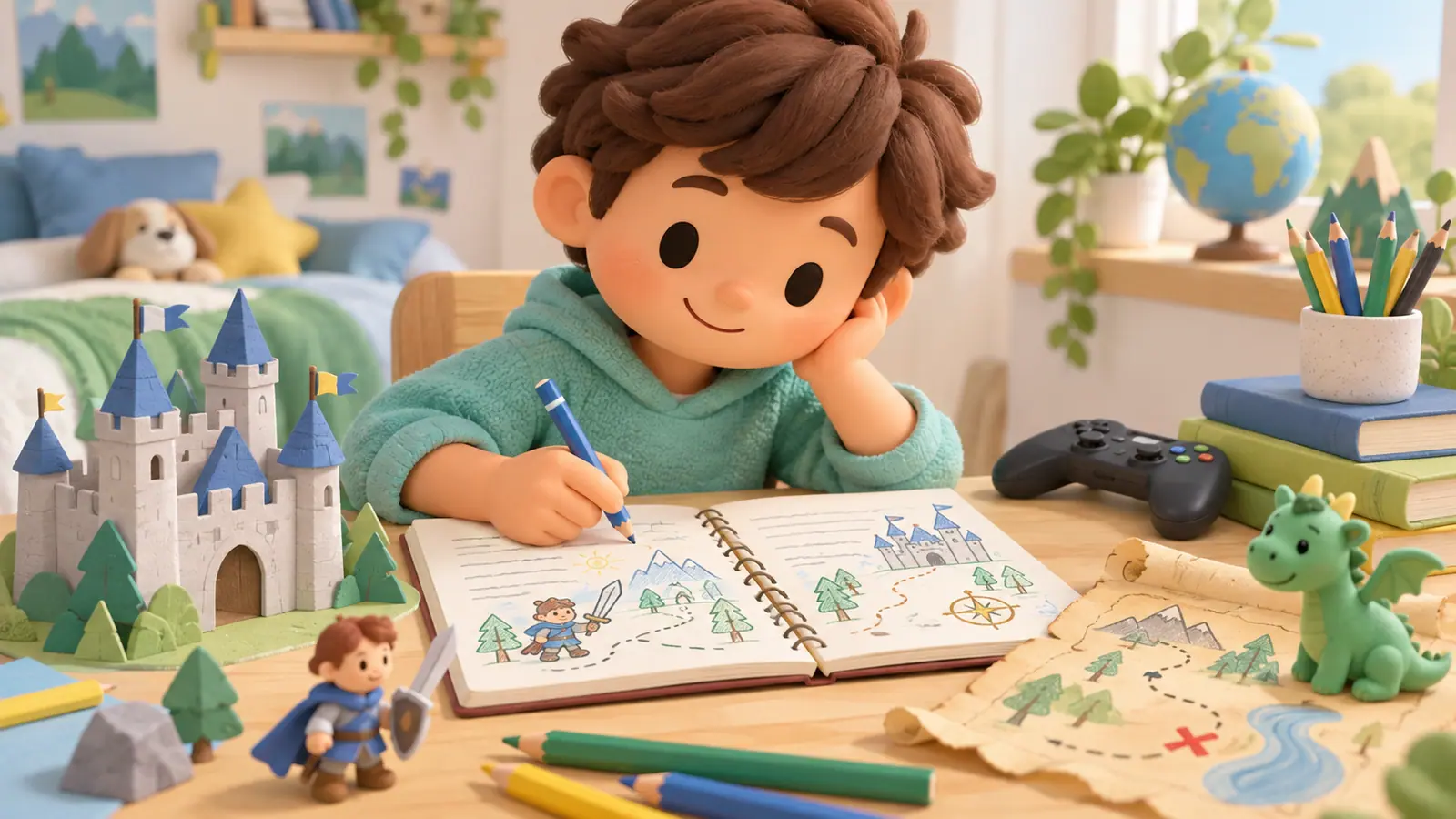
Writing prompts for kids who love games can begin with a quest, a world rule, or a decision a character must make. The aim is to help the child create something of their own. They do not need to retell an existing game's plot or write a long essay.
Offer a choice between two prompts. Let the child speak the idea first, sketch it, or dictate a first version if writing mechanics are getting in the way of planning.
Ten original prompts
- A bridge opens only when two rivals cooperate. Why do they need to cross?
- You design a level with no enemies. What makes it challenging?
- A guide gives the hero one useful instruction and one mistaken instruction. What happens?
- Write instructions for a game played with three paper circles and a pencil.
- Invent an item that solves one problem but creates another.
- A character can carry only two of five objects. Explain the choice.
- Write a message inviting a friend to a cooperative game and explaining the stopping time.
- Persuade a fictional town to build a library instead of another arena.
- Describe the same place first as a visitor, then as its caretaker.
- A player finds a shortcut that makes the game boring. Should they keep using it?
These prompts include stories, instructions, and arguments. Choose the kind of writing you want to practice before judging the result.
Turn one prompt into a small plan
For the bridge story, ask three questions: Who wants something? What is stopping them? What choice could change the situation?
A possible plan is: Mira wants to take medicine to the next village; the bridge needs two people to operate it; the only person nearby is a rival she refuses to trust.
That plan contains a goal, an obstacle, and a decision. It gives the child a reason to write the next sentence without prescribing every detail.
An example opening
“Mira pulled the bridge handle. On the far bank, the second handle stayed still. The gate between them did not move. Behind her, someone cleared his throat. It was the last person she wanted to ask for help.”
This original opening leaves room for the child to decide who arrived and what the disagreement was. Do not require them to copy its style or vocabulary.
Revise one thing at a time
After a short first draft, ask whether a reader can follow the main action. Then choose one improvement: explain a confusing pronoun, add a reason for a decision, or put instructions in the correct order.
For a rules text, ask someone to try the game using only the instructions. If they cannot tell whose turn comes next, revise that sentence. A real reader's question gives the revision a purpose.
Keep spelling feedback separate from every creative decision. You can correct one agreed pattern afterward instead of stopping the story repeatedly.
Give the work a finish line
The final piece might be one scene, five clear instructions, or a paragraph defending a choice. A short completed piece is a reasonable outcome. Do not quietly turn “write an opening” into “finish the whole adventure.”
Ask before displaying or posting the child's work. A private notebook can be its whole audience.
For other low-preparation activities, see screen-free ideas. If writing is assigned homework, our after-school routine guide helps keep the workload and support realistic.
Sources
We identify organizations and evidence types so readers can evaluate each claim. See our editorial policy.
- screen-free ideas — OMO Kids Editorial Team. Editorial guide.
- after-school routine guide — OMO Kids Editorial Team. Editorial guide.